Lovin' The Big Bang

A blog about big bore rifles

  • About

Does Accuracy Matter in a Hunting Rifle?

Posted by bigborefan on June 18, 2022
Posted in: Uncategorized. Leave a comment

That’s a very broad question that invites multiple answers, depending on what is intended by the question and the perspective of those who might attempt an answer.

First of importance is what is intended by the question. It might be interpreted by some as: “Inherent accuracy” of the rifle employing factory ammo. On the other hand, is it asking about the best handloads regardless of muzzle velocity – as in what many reloading manuals cite as the most accurate load for a particular bullet even though it might be 150 fps slower than the best in muzzle velocity. Then, to others they might be thinking 3″ – 4″ groups at 100 yards because they never shoot beyond that! So their answer might be: “As long as it kills deer at a hundred, I don’t care what the MOA is!”

And so on…

In my view it does matter for the following reasons, and this will likely be the opinion of at least a majority:

1) The accuracy of rifle loads – factory or handloads – that are intended for game from small to large, at ranges to 400 yards or so, must be consistently accurate enough to hit within the vitals of the intended game with the rifle zeroed appropriately.

> This whitetail buck was shot by our son, Brent, last fall (Brent is 6′ tall without boots). The .356 Winchester was zeroed at 100 yards and he shot it at 70 yards. The load was a 220gr Speer that I handloaded and zeroed for the Winchester M94 XTR. The bullet went through both shoulders and made exit. They were shooting MOA, so that part of the hunt was without angst.

< Zeroing the rifle at 100 yards.

If the rifle load chosen can only make 3 to 5 shots within a 2″ circle at 100 yards from a bench rest, then at 400 yards that would be approximately an 8″ circle. Given the possibility of some difficulty in having or finding a solid/stable rest, a wounding shot or miss is highly probable. On the other hand, 3 to 5 shots into a 1″ circle or less, has a much higher potential, under field conditions, of hitting vitals at 400 yards – depending, of course, on the class of animal. On a mature moose, for example, the vital area is at least a 12″ circle. On a 200 lb whitetail it might only be 6-inches.

In other words, using a rifle load that’s incapable of MOA for long-range shooting of game becomes a wild-guessing game. In Toronto there was a particular gun shop that I and a son used to visit on a semi-regular basis. The owner did his moose hunt annually in Northern Ontario. At the end of one such hunt, my son and I paid a visit, and I asked about his hunt – was it successful? He told us in his own Italian way ,with gestures and humour, that he took a very long shot on a moose with his “300 magume”, and it disappeared into some timber. “Did you hit it?”, I asked…. “Don’t know!”, was the reply. “Did you go after it?” – “No, it was too far!”. “How far?” “Far, far away!” was the only answer we got! Then: “My 300 is very good for long shots, you know.”. End of that discussion – except on the way home we had a good laugh, but also pondered the matter of irresponsible shooting at game animals.

To my way of thinking, not knowing the ballistics of my rifle, including its accuracy, is tantamount to criminal behaviour if I go afield to kill game.

2) Good accuracy – or the best possible – breeds confidence in the field so that becomes a matter of NO concern! I can then focus on making the shot!

3) There’s a real sense of satisfaction in owning an inherently accurate rifle, and in making handloads that complement its accuracy.

I’ve owned several of that nature, and there was real joy in producing ammo that brought the best from them. One was a single-shot NEF in .45-70 with a very stout barrel. It would shoot almost any load into MOA or better. That gave real confidence in sitting in a tree stand and firing a single 465gr semi-hardcast into the frontal chest of a trophy black bear at seventy yards. DRT! It never moved so much as an inch!

Another is my Tikka T3 in 9.3 x 62. All loads shoot sub-MOA. And the best is the 250gr AB into sub- 1/2 MOA at +2700 fps.

Still another was a .300 Win Mag… and so on.

And these were not loads tuned for accuracy, but for performance on game… like that 465gr at 1900 fps from a “cheap” rifle that would be despised by the “elite”.

Another rifle that was extremely accurate – more than I was – a Rem M673 in .350 Rem Mag, and that was after my gunsmith resolved some serious issues. It would shoot 3 of the 250gr Speer GS’s into a tiny cloverleaf of .375″ at a hundred – at OVER 2700 fps from it’s very stiff 22″ barrel.

4) Usually I like to settle on one load for hunting purposes from each rifle. It doesn’t always work out that way because I like to fiddle with different components, but in the case of my new .35 Whelen that’s exactly what I’ve been doing – one accurate load for “come what may” in a light-‘n-handy rifle. In the past, that was generally a .300 Win Mag but I sold or traded them all in favor of “mediums”. A .300 Win is very versatile, something like a .30-06, only more so in my view. A good 180gr is all one really needs in either of those two.

My 9.3 x 62 was intended to replace all mediums and sub-mediums. Replacing all mediums it has admirably succeeded in doing. But as an “all-purpose” rifle, quality lighter bullets are lacking. The lightest bullet I use in that rifle is the 250gr AccuBond – and it’s superbly accurate at 2600 – 2700 fps, but that doesn’t make it as versatile as a .35 Whelen on the “low end” where bullets of relatively high BCs and modest weight exist. The main problem with lighter bullets in 9.3 is relatively blunt shapes that come out of Europe. What is needed for the 9.3 x 62 is an American made 200gr “premium” with a sharp, polycarbonate tip, something like a 200gr in .358. Alas, that doesn’t appear to be on the horizon. GS did make a 195 bonded-core with a BT and pointed nose but they’ve moved to another continent.

So, a light-‘n-handy .35 Whelen appeared “out of nowhere” in a single-shot at a decent price, and it has taken a month of concentrated work to come up with a single, all-purpose load in a walkabout rifle for “come what may”.

The load: a 225gr AccuBond at 2850 fps that shoots three into .65″ at a hundred yards. That’s good enough for anything I might encounter that’s in season and for which I’m licensed to shoot, from 5 yards to 400 yards. That’s about as versatile as a .300 Win or .338 Win, with recoil in the same ballpark.

An inherently accurate rifle firing a consistently accurate load gives confidence and pleasure, but effectively using all that potential accuracy in harvesting game is the greater challenge that involves the shooter and his/her use of other support systems:

Shooting offhand (either standing or kneeling): Usually, this is less than 100 yards, but from a steady, standing position may be much longer, assuming the shooter is confident based on practice. I shot my moose from a standing-offhand position at 165 yards and both bullets went where aimed. On a more uneven ground I would have knelt or found a tree to lean against.

Another “trick” is using the sling as a support over the elbow of the offside – the one away from the shooting side. Go online and you can find the details if uninformed.

In kneeling, depending on whether the shooter is left-handed or right-handed, one knee is on the ground and the other is bent with the foot on the ground. The bent knee becomes the rest for the elbow of the hand that grips the forearm of the rifle, and the other becomes the arm and hand that controls the fire mechanism. Armies have used this style of rest in long-range exchanges of fire in open areas where cover or trenches were not available in an extreme and immediate situation.

Also, shooting offhand often involves close quarters and brush where an animal appears suddenly, jumps up or even charges within a few yards. The hunter’s only option is to instinctively “shoot now!” without any concerns other than hitting the animal “in the big middle”. In brush hunting where dangerous game might appear suddenly at relatively short range, I won’t be carrying less than a medium to big bore that can deal death and destruction with a single-shot, because that’s all I’ll get, one way or another! Either the animal’s dead, crippled or fled! Or I am!

Shooting prone: The support for accuracy is the shoulder, elbows and hands. There are various nuances to this, but open and flat terrain is assumed. But, I’ll not be shooting my .458 from prone, but maybe from:

A Sitting position: Again, there are a few nuances to this, but the deal is to find as much balance and comfort as possible. This position is often used with the back against a solid support, like a large boulder or stout tree. Often, this style is used in lieu of a tree stand or blind in areas of known wildlife activity.

African type sticks, bipods, tripods and permanent rests: No doubt we’ve all used various means for resting the forearm of a rifle for steadiness in shooting game. Even for relatively short range shooting. The reason isn’t complicated. If unsteadiness is removed, we can then focus the reticle on the spot we want to hit, knowing our next job will be field dressing the animal. A solid rest can practically eliminate shakiness and the effects of extreme emotion from excitement or nervousness.

< There’s a bear bait setup on the far side of this field. The range is 135 yards. The rifle is my Tikka T3 in 9.3 x 62. It’s accuracy gave calm assurance, but it’s also resting on an inherent rest of the ladder stand.

I’ve found solid rests to be very important in hunting bear, whether at relatively close ranges or longer ones. There is (for me at least) the excitement factor, and I don’t want to misplace a bullet as the result may become a tracking job in nasty places to find a bear that’s still alive seeking revenge – and that’s neither myth nor hype. And, very likely darkness has settled in! Tracking down a wounded dangerous black creature with sharp fangs and long claws that may outweigh me by a hundred pounds or more, and that extra poundage in the form of muscles, certainly can cause excitement that’s not of the pleasant kind! So I use rifle rests in blinds and tree stands when bruins with coats as black as coal is the pursuit.

Accurate rifles deserve accurate shooting! Otherwise, it’s a waste!

Til the next… Single-Shot Big Bore Rifles for Dangerous Game?

Shalom

BOB MITCHELL

+ + + + + + + + +

“Truth forever on the scaffold,

Wrong forever on the throne,

Yet the scaffold sways the future,

and behind the dim unknown

Stands God within the shadow,

Keeping watch above His own”

James Russel Lowell 1844

“the Present Crisis”

The .300 and .338 Winchester Magnums Compared – Which is better?

Posted by bigborefan on June 11, 2022
Posted in: Uncategorized. Leave a comment

Winchester came out with the .458 in 1956, the .338 in 1958 and the .300 in 1963. Over time I’ve owned and used all three. But at one time I thought I’d like to own their complete series of four, including the .264, at the same time and all in the M70. That is a set I could have lived with throughout my hunting life — I’m sure there are those who have done just that!

There’s little doubt that the most common and popular of those four is the .300 followed by the .338. Both are still widely embraced, if the sale of rifles, ammo, dies, bullets and discussions are indicative of their use. At one time – near it’s beginning in 1958 – the .264 was quite popular, then some problems developed, real or imagined. With such a large case for a relatively small bore, large doses of powder tended to create a lot of heat with the unhappy result of throat erosion. Then an ideal slow-burning propellant was difficult to find – either they were too slow or too fast for a maximum-efficient burn. Some claimed the .270 Win was better overall. Then Remington created the 7mm Remington Magnum based on the same case as the .264 with improved ballistics. Potential buyers of the .264 Win saw the 7 Rem Mag as a more favorable choice.

Yet with the current fad and resurrection of 6.5s as “wonder cartridges”, it appears a resurrection of the .264 Winchester Magnum is due – especially with more modern and appropriate powders. If I were younger, I could “dig” that one shooting a 140gr Partition at 3200 fps without fear of a “burnt-out” barrel in less than a thousand rounds! But it needs a full dose of “the right” modern powder – like 72 – 75 grains in a 26″ barrel and some “free bore”. Nosler’s #6 manual uses a 24″ test barrel and a max load of 57.5 grains of RL-19 for 3021 fps… about the same as a .270 Win! That’s scandalous for a cartridge like the .264 that can hold 84 grains H2O compared to the .270’s 67 ! Even I could do better having never owned a .264 Win! From a 26″ barrel and a 140gr NP or AccuBond, it should go not a hair under 3200 fps! Even a 7-08 can make 3000 fps from a 139gr and a 24″ tube using 48 grains of powder! Some of the results in manuals are void of making much sense – not all, but some…

Of course, Nosler now has their own magnum in 6.5 that is not under-loaded with a 140gr advertised at 3300 fps from a 26″ barrel…

Back to our theme: The .300 and .338 Win Mags… Which is better?

<This rifle was chambered in .338 Winchester Magnum when bought new. It’s a Browning A-Bolt SS in left-hand with a 26″ barrel. In that form it gave up to 2842 fps from a book load of RL-19 and a 250gr Hornady SP. Sometime within it’s first year I had it re-chambered to a .340 Wby Mag that shot the 250gr Partition to 3000 fps. That became my moose hunting load.

Having considerable experience with each in thousands of rounds of handloads, there is quite a bit of overlap with the .338 coming out on top in sheer energy numbers, while the .300 has slightly less recoil and flatter shooting for smaller big game. I’ve tended to favor the .300 as being slightly more versatile. But with the multiplicity of component bullets for each, the handloader can tailor ballistics for anything from bambi to brown bear. Though when it concerns a hunt for the likes of large moose and bear, under all conditions, I’d choose the .338 over the .300. In such a case, there’s no substitute for bullet weight, sectional density and energy, assuming the “best” bullets in each.

To get the best all-around results from each, a 26″ barrel is mandated. I fail to understand why a majority of hunters seem to prefer 24″ barrels. I’ve owned each in Browning A-Bolts with 26″ barrels and I defy anyone to prove why a 24″ is better in any sense. 26″ tubes do give increased velocities over 24s, all else equal. From my 26″, .300 I could quite easily get 3000 fps from the 200gr Partition, and 2840 fps from a 250gr in the 26″, .338 Win Mag, using RL-22 in the former and RL-19 in the latter, using a near identical amount in each.

At one time I was faced with a choice of either one in the same make and model rifle: the Ruger SS, M77 with the “boat paddle” stock. After some dithering, I chose the .300 as I already had a “heavy hitter” that filled that niche. Today, I’d lean toward the .338. Both had 24″ barrels.

While, as suggested, there are more than enough bullets of different types and weights for each, this is how I might load them today:

< A selection of .338″ sectioned bullets from L to R: 275gr Speer, 250gr Sierra, 225gr NP, 250gr NP, 250gr Speer GS, 250gr Hornady SP Int., and 225gr Hornady SP Int. (The bullet on far left is a .264″, 140gr NP for comparison). Today, there are many others, such as Barnes TSX and TTSX’s.

The .300 Winchester Magnum (26″)

Bullet: 200gr Nosler Partition

SD = .301

BC = .481

Powder: 73 grains of RL-22

MV = 3000 fps/3996 ft-lbs

300 yards = 2436 fps/2635 ft-lbs

500 yards = 2098 fps/1954 ft-lbs

The .338 Winchester Magnum (26″)

Bullet: 250gr Nosler Partition

SD = .313

BC = .473

Powder: 74 grains of Rl-19

MV = 2840 fps/4477 ft-lbs

300 yards = 2280 fps/2885 ft-lbs

500 yards = 1860 fps/1920 ft-lbs

Analysis of results:

1) Recoil: I’ve owned identical rifles in each with 26″ barrels, so the weight was similar at around 8.75 lbs with scope and ammo. The load for the .300 WM in a 8.75 lb rifle would be approximately 35 ft-lbs recoil. The load for the .338 WM would develop about 42 ft-lbs.

2) The .300 has a flatter trajectory but not enough to make a significant difference on large game such as moose or elk. However, for small deer, wolf or coyote, the .300 has an advantage at long range. But both are adequate for moose or elk to 500 yards at least.

3) In a choice for dangerous game like large grizzle or brown bear, and large Alaskan/Yukon moose, the .338 has a distinct advantage as most will be shot much closer than 500 yards. And the .338 has greater momentum from its 250gr even at 500 yards, as well as a higher SD and larger bore by 21% in cross-sectional area at any range from muzzle to terminal ballistics. So today (If I didn’t already have the 9.3 x 62) I’d choose the .338 over the .300 if given a choice between two otherwise identical rifles.

Then, there is the matter of 20% greater recoil from the .338 (depending on how each is loaded). If someone can’t be comfortable with the “kick” of a .300 Winchester Magnum (or other .300 magnums) then I’d certainly not recommend a .338. My .340 Wby produced 54 ft-lbs of recoil from it’s hunting load and I really couldn’t say it was punishing in the least. That’s considerably more than the typical .375 H&H. But with time and experience in shooting such rifles, blindfolded, it would be difficult to discern the difference between any of them. For a time I used a local smith for some work, who formerly worked for the Canadian military as a smith. He told me: “I did so much testing that they were all just another firearm. I couldn’t honestly tell you the difference between a .458 or .30-06, they are all just another firearm to me”.

I pretty much came to that same conclusion. The biggest difference in “felt” recoil was the rifle itself – its form and did it “fit”? Weight was also a major factor. Then, how I held it in bench shooting. I learned early on to pull it tight to the shoulder WITH BOTH HANDS! And don’t slouch – sit up straight allowing the body to move with the recoil as in shooting offhand in hunting.

If one only learns to shoot small bores as in benchrest style, they’re gonna get whacked in the chops real hard if they use that “style” for a .338 Win Mag, and maybe from a .300 too!

In my view, Winchester did a great job in producing that series of four in the late ’50s and early ’60s, that have really never been improved on by their “Short Magnums”, nor other brands and iterations. The .458 is still a factory standard for African DG firing a 500gr at 2130 to 2150 fps (over 5000 ft-lbs), and handloads that equal or surpass the Lott (to 6000 ft-lbs); the 300 is a world class cartridge for big game at any realistic range as well as a favorite for target shooting. The .338 is still a serious choice in Alaska for its overgrown moose and bears, and the .264, despite a lot of negative press and more than enough competition, is still alive and capable of “getting the job done” on anything to meet Winchester’s intentions – at stretched ranges.

Long may they live!

< Three heavyweights loaded for my Ruger No.1 Tropical in .458 Winchester Magnum. L to R: a 600gr Barnes Original, a 550gr Woodleigh Weldcore and a 500gr Hornady DGX. The one in the middle was fired today (Friday, June 10/22) along with several 250gr MonoFlex’s. The rifle is sighted for those 250s at 2686 fps MV/4005 ft-lbs that cluster into a tight group at 50 yards. A .458 WM can shoot that bullet to 3000 fps with ease! The 550 Woodleigh registered 1657 fps, and corrected to MV = 1666/3389 ft-lbs, which is adequate for anything short of elephant. That’s a greatly reduced load, but within range is more than adequate for the largest and most dangerous game Alaska can throw in its direction! That bullet at “full bore” can easily register 2200 fps from a 24″ barrel at the COL presented above.

(A couple points of interest for the curious: 1) Though the 250gr MonoFlex at 2686/4005 ft-lbs appears more suitable for big bear than the slow 550gr Woodleigh at 1666/3389 ft-lbs, the 250gr would have to make 3665 fps to equal the momentum of the “slow moving” 550gr, and 2) The 550gr actually retains its velocity-momentum much better down range than the 250gr due to a significantly higher B.C. So, the effective range of the 550 on large game is better than the 250gr, though compensation for a meaningful disparity in trajectory would have to be made. Another note: Felt recoil from the 550 was noticeably more than from the 250gr – 34 ft-lbs for the 550 vs. 29 ft-lbs for the 250 – all within the range of our two main subjects, the .300 and .338 Winchesters.)

And despite its critics, the father of them all – the .458 is not only able to fulfil its promises, but is better than ever!

Til the next…

Shalom

BOB MITCHELL

What’s wrong with the .458 Winchester Magnum?

Posted by bigborefan on June 4, 2022
Posted in: Uncategorized. Leave a comment

“Wonderful” is an adjective to describe how full of wonder and amazement something is. It has been applied to music, art and creation itself, plus a myriade of other objects and even to some persons: “She’s a wonderful person!”, it has been said of some mothers, for example – certainly true of my mom.

Lots of positive adjectives could rightfully be applied to the .458 Winchester Magnum when used in a rifle that complements its character and attributes. Currently, a thread on the 24hr Campfire forum is titled: “The great .458 Winchester Magnum. Everyone should own at least one!”. It’s now at 111 pages and contains encyclopedic information and knowledge… if you can also appreciate some lighthearted jesting.

But there are some professional writers for outdoor-sporting type magazines who still appear to be in the dark of the .458 Winchester Magnum’s true capabilities — or wilfully blind! According to them, the .458 Lott has filled the void of what the .458 Winchester Magnum should have been from its beginning in 1956. “So, today, there’s really no need for a .458 Winchester that falls short on its promises and can’t possibly keep up with a much better creation in the Lott”, or so that has been the spewed propaganda for a potential gullible, wannabe hunter of large and dangerous game!

I’m not sure when or how I first learned about the .458 Winchester Magnum. When my good friend, Glendon Rae, said he was going to Kenya as a missionary and would be taking a .458 Winchester Magnum for big game hunting, I thought that was awesome! That was in 1960 or ’61, and I was already aware of the cartridge, but unsure of how that came about. Anyway, for years to come, when they returned from Kenya on furlough every fourth year, they visited us in Quebec and he gave details, with 35mm slide shows, of his hunting ventures until it was shut down in 1977.

<A Winchester M70 in .458 Winchester Magnum

His rifle was a Winchester M70 African in .458 – one of the originals – and his ammo was Winchester’s own, softs and solids, that worked as they were supposed to on everything he shot, including elephant and Cape buffalo — he’d shot many of each over a period of several years — never a squib load or misfire. A .300 magnum – perhaps the H&H – was used on plains game with equal success — keeping in mind that he wasn’t a handloader.

I’ve yet to fire a factory round in any of the three .458s I’ve owned: my first a Ruger M77 with a 22″ barrel and tang safety – which I much prefer to any other type. My current No.1 Ruger Tropical in .458 Win also has a tang safety. That may have something to do with the fact of my blind right eye that has forced me to shoot from my left side since I started shooting a BB gun as a youngster having had an accident to my right eye at age six. Whatever the reason, I much prefer an ambidextrous tang safety. Additionally, I have relatively small hands that makes it difficult to hold onto the pistol-grip of a rifle with my left hand and reach the safety on the wrong side (for me) in a right-handed bolt action.

My handloads for that first .458 were for a moose hunt using the 500gr Hornady RNs at about 2000 fps – obviously not a max load. The propellant was H4895, 69 grains ignited by F215 M primers. They shot 1-hole groups of three at 100 yards. But I didn’t get a chance on a moose that season – in part due to the remnants of a hurricane that went through our hunting area. The next spring I did shoot a young bear at 75 yards using the 350gr Speer at around 2345 fps/ 4273 ft-lbs. It was a going-away shot that took the bear behind the short ribs and came out behind the head, removing several inches of spine and the back of its head. But that young bear was tough! It still had enough spunk left to clamp its jaws on a 3″ exposed root of a tree and we literally had to pry it off – when it was stone-cold dead!

My next .458 Win Mag was the CZ 550 with a true Magnum Mauser-length action and box, and a 25″ barrel. It was long and heavy compared to the compact and stout Ruger M77. BUT! It taught me how capable and “wonderful” a .458 Winchester Magnum could be when given its due respect! Its balance belied it’s weight, its accuracy superb and it’s versatility and power unmatched by anything I’d previously or later owned – including my .340 Wea. Mag. On June 30/08, Temp +20C, elevation 900 ft, three 500gr Hornady RNs averaged 2286 fps/5801 ft-lbs (corrected MV) over 80 grains of H4895, ignited by WLRM primers in Winchester cases. COL was 3.53″. That CZ550 taught me what a .458 Win IS, not “wants to be”!

Since that experience, the Ruger No.1 in .458 (my 3rd .458) has shot that same bullet to 2317 fps/5960 ft-lbs using 81 grains of H4895 (1 grain more), same primers and brass and COL. That was in May, 2019, eleven years later from a 24″ ported barrel! And it has made OVER 6000 ft/lbs energy from particular loads since.

< From my Ruger No.1 Tropical in 2020: (Pic on the header) Instrumental reading at 15′ from the muzzle. Corrected to MV = 2787 fps/6036 ft-lbs from a 350gr TSX.

But now it’s time to slow things down as it’s been awhile since I’ve seen another elephant in our back yard. But one morning this past week, at 6 a.m., there was the biggest-fattest coon on our back deck I’ve ever seen anywhere! And that’s no hyperbole! When I stepped out and confronted it, it backed into a corner of the deck, stood up with eyes large and glaring, and snarled at me! He was two-feet tall (later I measured where the top of his head was)! I took a step in its direction and growled back! At that, he decided I might be meaner than he was, so swung around and had real difficulty escaping by squeezing between the spokes of the railing, then waddled across the back yard to the chain-link fence, climbed over and down the other side to disappear in the trees of a neighbour’s property… man, was it ever lucky that I didn’t have my .458 Win in hand! That thing must have weighed 25 lbs at least! Have you ever confronted a coon that big without a .458 Win? Even a 5 lb coon can be dangerous if cornered… and you try to pick it up!

Back to sanity… almost!

In reading, listening to, and watching some videos — articles, stories and videos alike would make all gun stuff pretty serious! And if you are at the right end of a big boomer, and confronting a real hairy monster, like a 700 lb grizzly, then matters tend to get more than a little tense! What would you – in real time – prefer to have between your hands as a rifle? Think about that in palpable terms – if you haven’t! And let’s say you’re hunting elk… and have one on the ground with the guts out… and alone!

I’ve thought about that sort of thing quite a bit – we don’t have grizzly in these parts (that we know of) but we do have some pretty aggressive bears that might covet your deer, bunny or grouse!

Have you ever used your Big Bore for deer, bunny or grouse? It makes for good practice! Once on a bear hunt with a friend my age – who was a novice hunter – I’d shot a medium bear with my Ruger #1 in .45-70 LT. The load was a 500gr Hornady RN at ~2200 fps, about the same as a max load from a .458 Win with a 22″ barrel. My British friend was a witness to all that and wanted a chance at a bear for himself. A week later we were at the same location and a family of coons went grocery shopping at our bait setup! I instructed him to start shooting as they would clean out the store before another bear got a smell of anything. He was shooting .308 Win handloads of 165s I’d put together for him. With a British military background, he opened fire knocking off two while three others took off for cover in the surrounding trees. My friend weighed in excess of 300 lbs, so was not the most mobile citizen in Canada, so I ran after the largest remaining and caught up to within 35 yards or so, and let loose with the same load I’d used on the bear the previous week… that coon literally exploded with fur and guts adorning branches of the surrounding trees! Yup! .458 ballistics will work on coons too!

< Uninvited guests to a party for bears!

There are two typical reasons (excuses?) why many hunters say they don’t need or want something as ferocious as a .458 WM: 1) They don’t need it for hunting, and 2) They don’t want the expense. Yet: 1) They use “ridiculous” cartridges for hunting bambi anyway!, and, 2) There’s no end of expense they go to, to have three more 6.5 Creeds!

So my take is: 1) They’re afraid of “the pain”, imagined or real, and 2) They don’t want to be criticised (or laughed at, ridiculed?) by friends or others for showing up at the range or hunting camp with something that doesn’t “fit” the occasion. We’re going to be criticised by some regardless of intent, but “be true to thyself” – meaning: we must maintain “self respect” in all decisions and choices.

So, go ahead and try that BIG BORE, not because I said so, but because you want to! If you really don’t want to, don’t let me or anyone else make you feel guilty or inferior.

Me? I’ll tote my .458 Winchester Magnum to the range and to the woods, not conscious of the feelings or thoughts of others, but only aware that if I meet up with a 25 lb coon, it’ll be in big trouble!

I might even test one of those 550gr Woodleighs… or better yet, a 600gr Barnes Original! Do ya think that’ll be “enough gun”? One gun and one load for coons and big bears! Say…. aren’t they related?

< “Whacha doin’ up there, son?”

Shalom

BOB MITCHELL

Analysis of Rifle Ballistics

Posted by bigborefan on May 28, 2022
Posted in: Uncategorized. Leave a comment

Much has been written and stated on this theme and much more could be, though it probably wouldn’t add much to our way of thinking … because “we know it all” anyway. Right? According to “some” that appears to be the attitude.

Several of my “early years” were invested in the formal study of the entire Bible, Theology, Christian Education and Practical Ministries (Pastoral, Missions and Evangelism), but it wasn’t until I engaged in those activities, and made practical application of those “tools”, that my true understanding and maturity developed exponentially. The same method applies to most professional work and activities. Because I was fascinated with the heavens, I wanted to see what was “up there”! That resulted in intense study of manuals on how to build your own telescope… that actually resulted in building four reflecting Newtonians (mirror type): three 10″ diameter parabolic mirrors, and finished a fourth 10″ for a friend, a 4.25″ RFT, and finally, a 12.5″ compound Dall-Kirkham (modified Cassegrain). The first 10″ was made from a 1″ thick porthole glass that worked but was not a resounding success because it wasn’t made of Pyrex and not thick enough to be stable under extreme temperatures. The others worked fine and actually gave better viewing than my current commercial 8″ Celestron Cassegrain because they gathered much more light and gave better resolution. But I didn’t learn “all that” on day one! It was a process, but I set the standards high and went for “big bore” mirrors! Newtonian and Cassegrains are mirror-type telescopes just like the biggest in professional observatories. Usually, beginners of telescope making start with a 6″ Pyrex blank.

< The 8″ commercial Celestron has a combination of optics involving an 8″ front lens, an 8″ front surface concave mirror at the back end, another convex mirror attached to the front lens on the inside which magnifies the image sent back through a hole in the center of the main mirror that in turn is reflected by a prism or flat mirror at 90 degrees to the eyepiece(s) at the back for viewing. The main front lens and two optical mirrors must have a total optical correction of better than 1/8th wavelength for all light rays gathered by the 8″ optical front lens and mirrors to form a sharp image that can be magnified by up to 400 x without distortion. Of course, much depends on the lack of turbulence in the atmosphere (which is also a lens) on a given night. But on rare occasions I’ve been able to use my own home-built 10″ telescopes to 600x in the observation of Saturns rings and Jupiter’s belts, spots and moons casting their shadows on the surface of its “clouds”.

Applying that methodology to analysis of rifle ballistics, it’s plain that levels of knowledge and experience prevail. And it’s also plain that the degree of precision in the analysis of ballistics doesn’t compare with that called for in optics, astronomical or otherwise. The astro mirrors I made – all six of them – had to be ground to a perfect concave sphere, polished and corrected to a perfect parabolic form – within a minimum of 1/8 wavelength of light throughout their entire surfaces, to bring all light collected to a sharp focus of an image. Eyepieces of various magnifications were then used for viewing. Mine, on average, were better than 1/10 wavelength. There are instruments and methodology for doing that. 1/10 wavelength of yellow light is: 1/10th of about 580 nonometers, or 58 nanometers. A nonometer is 1 billionth of a meter (American sp.).

I mention this to say that whether it be biblical knowledge and application, telescope knowledge and application or rifle ballistics and application, I have used the same methodology, and then ask the question: “DOES IT WORK?” For example: “Did God really answer prayer given by faith in HIM?” – as per biblical instructions. Did the instructions I received in manuals for the construction of reflecting telescopes actually get the job done – DID IT WORK?

Directions and instructions given (M.div. in theology for example) are “tools” that are “interpreted” through application! So the application of a “tool” causes maturity in understanding, and is a PROCESS!

For some it’s a looooong process, for others: much shorter! It’s been said: “It’s better to sharpen the axe before you cut the wood!”, or words to the same effect.

By nature, I’m an analyst – so “they” tell me…

So, I started with Lyman as my first book on reloading, and Speer my second (which I still have). Lyman was used for my first handloading exparience – a .30-06, and Speer # 11 (Omark Industries, Inc. 1987) for my first .45-70 – a load right from page 316, and 56 grains of H322 (as in telescope making – I started “big”, with large aspirations). So that didn’t give me their results (1886 fps from an 1895 Marlin, 22″), so I added one grain more and got an average of 1865 fps that became my load… I killed my first bear with that “almost” book load! And I used the Speer 400gr bullet!

My method was: Instructions and experience. Then: “Did it work?” < The proof!

When we find out what “works”, and why, we mature from childhood to adolesence, then on to young adulthood, etc. I don’t read my bibles much anymore because I know too much already! Two exceptions being: when I want to hear directly “from above” a message for the day, or future, and reminders of biblical truth because I’m forgetful of lessons learned! Same with reloading manuals. It’s been a few years since I’ve bought one… but the new Speer interests me for the sake of the .35 Whelen and “new” powders, so I go online for that.

But God has given us a gift of eternal life through His SON, Jesus Christ. BUT… we only know the TRUTH about that through “the manual” he has also given… the BIBLE! And today, a vast majority of the “western world” don’t know what’s in it because it’s been “put down” by so-called “well educated” people who, themselves, don’t know what’s in it!

The BIBLE is a good manual for life and eternity, but it does no good it it only collects dust! Much the same as anyone reading Hornady’s manual when they don’t even own a rifle, and are negative about that!

I read the Bible through from the first verse to the last when I was 12 years old. And that was in the King James Version. And that wasn’t the last time I read it through.I believed it then and I’m more convinced than ever “that it works”, from experience over 3/4s of a century!

< That’s my wife, Adrienne, on the left of a couple I united in marriage in 1965. We visited with them in the Montreal area on our return trip from the celebration of our 60th anniversary in New Brunswick in the summer of 2017. He became pastor of the French congregation in Montreal when we moved to Ontario in 1975. When he retired a few years ago, they moved north of Montreal where we visited them. They remained faithful to each other, and in love until she died of cancer late last year. She was always a great support to Pierre and a very positive person due to her faith in the LORD. And Pierre also, he misses her greatly but is thankful for their many years together – and one day soon they’ll be together again! DOES IT WORK?

Anyone, whatever their credentials, who wants to debate “signs” of pressure in stating “It ain’t possible” – after handloading for 43 years a good variety of cartridges, and several rifles in many of those cartridges, I will say “signs” are VERY important!

Currently, after five firings of the same cases in .35 Whelen using increased loads of CFE 223 from 65 grains to 69 grains, I’ve measured the heads and length of those cases after each firing. There has been slight growth in the brass but still within specs without trimming, and CHE is still slightly less than a max load of RL-17, which in itself is a safe load. These are the same cases, starting from new, never previously fired. All fired primers look identical, no soot blowing back around case necks, etc. I could safely use these same cases for another three to five firings with the same load. How do I know that? From experience!< .35 Whelen “stuff”! On the left – those were new cases, now fired five times. They will be used again. On the right – in the back corner are six reloads reserved for hunting. That will be their second firing. They are loaded with the 225gr AccuBonds over 69 grains of CFE 223. They are primed by WLRM. COL is 3.45″, and expected MV should be the same as when previously tested at 2835 fps MV. In the front right are three once fired, and three loaded with the 225gr Nosler Partitions. That will be their second firing at about 2770 fps MV.

How do I know my Father in Heaven answers my prayers/ hears me when I talk with Him? From experience! As someone responded to the query: “How do you know God exists?” Immediate response: “I talked with Him this morning!”

And as I responded to an atheist who challenged a small group of Christian men with:”God doesn’t answer prayer because he doesn’t exist!” My immediate reply: “You would have to be God to know that he doesn’t exist!” Obviously, an impossible proposition!

So, which is more important: Knowing a rifles ballistics or personally knowing God? Wanting empirical evidence for the existence of God is both normal and available to those who are genuine in their search. And equally so for those who want empirical evidence that a particular load from a manual is fully trustworthy in a new rifle-cartridge project.

How would you determine each?

My methodology (again): First: Instruction, Second: experience, then: “DOES IT WORK?”<It worked for him – son Brent. My handloads in his .356 Winchester .

Til the next…

Shalom

BOB MITCHELL

Why HUNTERS Choose Particular Rifles

Posted by bigborefan on May 21, 2022
Posted in: Uncategorized. Leave a comment

The emphasis here is on HUNTERS, not necessarily shooters, though being a hunter that uses a rifle as his/her tool for the job doesn’t exclude him/her from also becoming a “shooter”.

A majority of the men I encounter at the rifle range would mostly be “shooters”, and perhaps less than 50% are also hunters. I don’t know the total current membership, but it’s well over a thousand. The OSHAWA CLUB and TARGET RANGE has been around, at the same location, for 100 years and incorporated in 1939. Back in the day, most were hunters. When I joined the club in 1988, membership was about 350, of which the vast majority of rifle shooters were also hunters, and a goodly number of the 350 was due to the shotgun sports “up top” where the clubhouse was, and still is. While any member can be involved with the shotgun sports (and there is international competition scheduled from time to time): skeet, trap and sporting clays, it appears a vast majority are elite business men, or retired as such if their equipment and vehicles are any indication. I don’t participate, not because I’m negative about it, but since it holds little personal interest.

< I shoot at the 50 yd, 100, 200 and 300 yd berms. To the left is a pistol range, and further left a range for bow hunters. In the upper right-hand corner of the pic, over the trees is the clubhouse and shotgun sports. I’ve been a member here for over thirty years. That’s my .458 Win Mag ready to shoot over the Chrony.

How things have changed in the last fifteen years or so – hundreds have joined as shooters, not hunters! Then some “old timers” no longer hunt but enjoy bringing out some of their vintage rifles just to shoot them… or have added something new for fun!

Politics has also stuck its nose in by passing laws that force shooters and hunters to practice at Federally authorised ranges. Of course, there are rifle and shotgun hunters and shooters (the hunter being also a shooter) who have built their own “ranges” on their private properties, mostly farm land. I’ve a former hunting associate who does that very thing. But since he’s a sheep farmer, and also works for the Provincial Government as an assessor of damage to livestock by predators (fox, coyote, wolves and bears), he totes a .243 Win on his own property of several hundred acres in protection of his sheep. He also has a private range where he practices with his .243 Win and .50-cal BP.

< Brian, the owner of the sheep farm, is doing the skinning. Ken, my partner, is holding the leg as an assistant. That was a bear I’d shot the day before with my 9.3 x 62. Brian auctioned the hide and that was his “payment” for his share in the matter. On this farm there is a personal range.

So, basically, many handloading hunters join ranges for development of hunting loads, practice, sight-in, and some “fun”. Unless a hunter is somewhat reclusive, he will enjoy the comradeship at a range where hunting stories are free – they don’t have to be “the whole truth and nothing but” – something like “fishing” tales, and information is shared about “loads” – but few will give “all the details” – like a secret recipe in cooking where a necessary ingredient is conveniently forgotten or left out!

In talking with a fellow hunter-shooter “the other day” at the range before shooting could commence at 9:30 a.m. , we discussed his .375 H&H with which he’d shot a Cape Buff. I asked about his bullet and load since I’d owned a couple of .375 H&H’s. He rambled on a bit about what he was currently shooting, mentioning IMR 4064 and RL-15, but never did answer my question! Hunters will gladly describe what they successfully used (if they remember or know!) Shooters often won’t!

That’s a preamble to our question: Why do HUNTERS choose the rifles (or rifle) they do in actual hunting, or in planning for a hunt? In my last blog, I suggested several possible influences to that choice.

A generic single rifle choice, such as a .30-06, .270 Win or .308 could be common for an adult North American hunter for most game starting out. That would involve some knowledge of their ballistics and application.

But for a young hunter of 12 or so, who is under the supervision of a licensed parent or “guardian”, the recommended choice will likely be different. There are several good choices available for youth: If there’s a family heritage of hunting and shooting, it could be something with about 1800 – 2000 ft-lbs energy at the muzzle: a 25-3000 Savage; .30-30; .257 Roberts, etc. Today, a common cartridge for youth is the .243 Winchester. Then again, far more depends on that young person themselves: Their background, likes, strength, intelligence, adaptability, etc.

As concerns the “fairer sex”: Again, there are many variables: Interest level, experience, age, adaptability, intelligence and physical strength.

There was a time in which history records that every family member from youth to grandparent was expected to be physically able, and know how, to use the family firearms to put meat on the table, and for personal and family protection. In many instances that was not “firearms” but “firearm”, singular.

In today’s world of hunting, rarely is a firearm necessary “to put meat on the table”. It is generally considered for “recreation” or “sport”. Of course, in most (not all) hunting scenarios the meat must be consumed by the hunter and his family, or friends and associates, or given to a local “food bank” (with legal permission). Even in most parts of Africa, the meat belongs to “the community”. And Alaska: While the major towns and cities (Few there are!) have markets where fish, pork and beef are sold, yet most in the “outback” must forage protein using a firearm. Also, since Alaska and the Canadian Yukon have the largest ungulates and bears, it behoves them to own the most suitable weapons for both defensive and offensive purposes.

< A typical African village in the area I visited in early 2000.

< No mater the rifle-cartridge used, it can’t do this job!

In the world of hunting today, Africa, Alaska, the American Northwest, and the Canadian North have kept the production of medium and big-bore rifles alive! Of course, beyond that necessity, many shooters want to experience that kind of power! It’s like wanting to own a twin-turbo sport Mustang instead of a utility four-banger with 150 hp. As an enthusiast myself, I find it very intriguing that more and more of the Sport SUVs are turbo-charged V6’s with around 400 hp! Yet they still give better mpg than some of the older V8s of the the late past century that produced less than half of 400 hp! Around here there are more late model pickup trucks than any other type of private vehicle. At around $65,000 average per pickup, that’s well beyond my reach, but not to say I wouldn’t like one, and the excuse would be “for hunting”!

So you don’t “see the need” for 400 hp, while 1/2 of that is more than sufficient? Are you then as “efficient” in all other choices of life? Whether we like it or not, our choices are a reflection of who we are and what matters to us… assuming we’re not going head-over-heels into debt! Cars, trucks and SUVs may be just a “tool” to some, while house, furnishings, electronics, gadgets, clothes and investments must be the “best” – no expense considered too much. It’s a reflection of who they are… and who we are!

Same with rifles for hunting: I’m not making a fashion statement, but for security and success while hunting anything, anywhere under all conditions, I choose rifles and their cartridges based on what I consider “best” , not just “good enough”! I don’t need a .458 Win Mag for black bear hunting, but through experience I’ve learned that a “hot” loaded .45-70 will drop ’em “right there” without a CNS hit! It’s easy work to load a .458 Win like a “hot” .45-70! I like the .458 Win because it’s more flexible than any other, and due to it’s versatility in bullets from 250gr to 600gr, it’s straightforward in making equivalent black powder loads of less than 2000 ft-lbs at the muzzle all the way to 6000 ft-lbs from particular propellants and 450gr to 500gr projectiles. It’s a lifetime of work and experience to accomplish all that one rifle in .458 Winchester Magnum is capable of! But to use that as a justification – no matter it’s truth – still falls far short of making it a choice strictly based on need – unless one lives in remote Alaska, the Yukon, or spends scores of thousands of dollars in hunting Africa’s DG. But even then there are other choices. My honest rationale for owning a .458 Win Mag is because I like Big Bores, and in my thinking, it’s the best of it’s class!

< Mine doesn’t get lonely, like a hunting dog left behind when need or companionship calls for it!
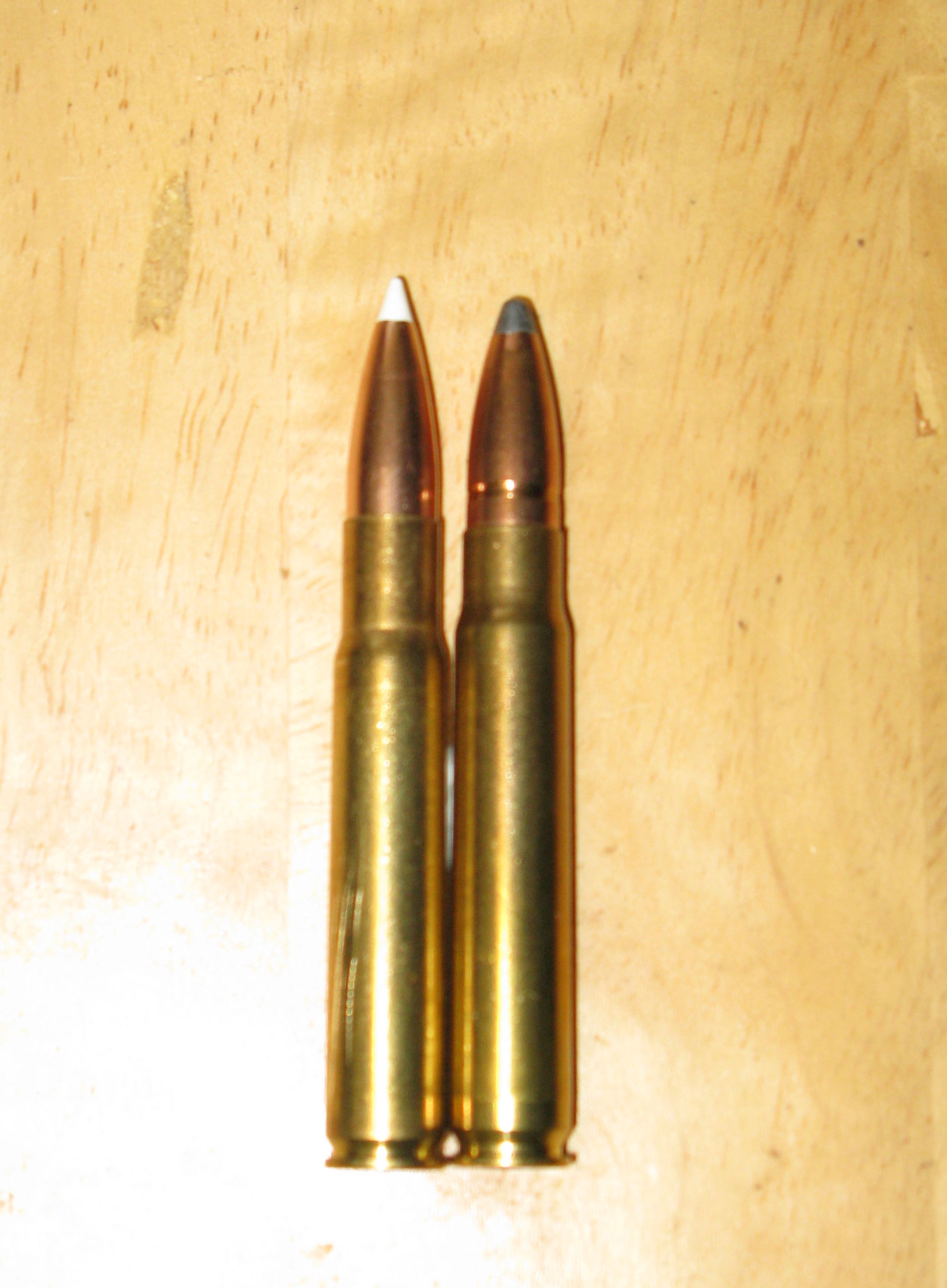
So, a mammoth amount of time in research, analysis, work and experience is involved at home, the range and the field to bring it all together in deciding on a rifle and load for anything, anywhere, and under all conditions.

After a full month of “mammoth” commitment and work with one rifle – the G3 in .35 Whelen – I’ve finally found rest with the results. Working with two propellants – RL-17 and CFE 223; a full box of 225gr AccuBonds, plus a few others; four trips to the range and two in hunting; and three rifle scopes! Results: an accurate load of 69 grains of CFE 223 under the 225gr AccuBonds, in Rem .35 Whelen brass, 3.45″ COL, ignited by WLRM primers for a corrected average of 2835 fps/4015 ft-lbs, sighted dead-on at 100 yards.

Or, we can read the opinions of fifty-two others on the Internet who are keyboard “experts”… ! Yet… a handful of intrepid handloaders are! Thank you!

Til the next…

Shalom

BOB MITCHELL

The .35 Whelen and 9.3 x 62 Compared

Posted by bigborefan on May 14, 2022
Posted in: Uncategorized. Leave a comment

I have both, and have enough experience with each in handloading and hunting to make some unbiased comparisons and contrasts.

<.35 Whelen on left and 9.3 x 62 on right. Both are real loads not mock-ups. Both loads have been made from virgin brass – never reloaded. The Whelen case is Remington and the 9.3 x 62 is Hornady. In H2O, the Whelen brass holds 72 grains and the Hornady case holds 77 grains. By way of comparison the .350 Rem Mag case holds 74.

The .35 Whelen is loaded with a 225gr AccuBond over 67 grains of RL-17 (a compressed load), and the 9.3 x 62 is loaded with 68 grains of the same powder (not max) under the 286gr Partition. My “normal” load is 70 grains of RL-17 for that bullet which is also a compressed load. Both cases are primed with WLRM primers. COL for the .35 Whelen is 3.45″, and for the 9.3 x 62, COL is 3.37″ (constrained by the clip magazine, whereas the .35 Whelen is loaded for my single-shot). The Whelen case is longer in the neck, reducing capacity compared to the 9.3 x 62 which has a shorter and wider neck. The case body of the 9.3 x 62 is both longer and slightly “fatter” than the Whelen, explaining the differences in case capacity.

I’ve found, by experience in reloading each with the same RL-17 powder, that the 9.3 x 62 will hold a maximum of 4 grains more of the same RL-17 powder than the .35 Whelen to a point at 3/16″ below the case mouth of each for seating a compressed load of the 286gr NP or 250gr AB in the 9.3 x 62, and a 225gr AB and 250gr NP in the .35 Whelen, without undue pressure or bulging the respective cases.

Therefore, any potential advantages of one over the other for large game goes in favour of the 9.3 x 62 due to better case capacity and improved efficiency in the use of the same powder due to its slightly larger bore. The long and the short of this means that, generally, the 9.3 x 62 can shoot a 286gr at nearly the same MV as the .35 Whelen can fire a 250gr, with the sectional density favouring the 286gr at .305 vs .279 for the 250gr in .358 cal. Though appearances can deceive, yet expansion ratio rules. 358 is one of the best, but 9.3 (.366) is slightly better. The G3 in .35 Whelen has a 22″ barrel and the Tikka T3 in 9.3 x 62 sports a 22.44″ barrel. I’m expecting 2650 fps from a 250gr from the G3 in .35 Whelen, and I’m getting 2640 fps from the 286gr Partition in my Tika T3 in 9.3 x 62.

Those are facts of physics, but it remains for the handloader to exploit the best from each depending on his/her temperament, aspirations, knowledge and components used in propellants and projectiles.

If I wanted, I could make my .35 Whelen superior in ballistics to my 9.3 x 62 Mauser by loading the Whelen to a SAAMI standard of 62K psi for a 250gr and the 9.3 x 62 to a CIP standard of about 57K psi for a 250gr. But I couldn’t live with my conscience if I promoted the Whelen as superior to the Mauser in shooting 250gr bullets! I’m a “hot-rodder”! I want the most from whatever “it” can give, within safety bounds! You know, I’ve never (yet) had to use a mallet to open a bolt-action rifle! But at this stage of life I’m willing to go a wee-bit less than full throttle! But any “loads” I share here are less than that new .338 RPM cal Weatherby at a SAAMI approved 65K psi!

Here’s some interesting data I’ve uncovered in using something other than the latest “news” for the .35 Whelen: RL-17 is listed quite a bit “slower” than CFE 223 in the HORNADY Handbook of Cartridge Reloading, 9th Edition, page 38 of POWDER BURNING RATES: CFE 223 is at 99 with RL-17 at 116 (slower than IMR4350 and A4350! CFE 223 is just ahead of BL(C)2 at 98.

YET!!! 67 grains of RL-17 in the Whelen under the 225gr AccuBond (max compressed load) gave slightly higher velocity than 68 grains of CFE 223 motivating that same bullet!

RL-17 = 2811 fps corrected to MV from 67 grains. ES = 5 fps. Accuracy at 100 = 0.76 (3/4″)

CFE 223= 2799 fps corrected to MV from 68 grains. ES = 6 fps. Accuracy at 100 yds = 1.4″

Since RL-17 is MY powder for the 9.3 x 62 Mauser, I’ll stay with that for the Whelen as well. (Anyone want a 2/3 can of CFE 223?)

But, in all fairness, I might be able to use 70 grains of CFE 223 for the 225 AB, as it’s a ball powder that takes less space in the cartridge than RL-17, and it seems to work better (more consistent and better accuracy) the “hotter” it gets! Also: it shows far less CHE than any other powder, including RL-17! That’s in the same batch of .35 Whelen cases that was being used for the 4th time in each.

So, I’m really not ready to sell CFE 223 just yet without trying 70 grains under the 225 AccuBond. That might improve ES and accuracy, which currently lags behind RL-17. Two grains more of CFE 223 should increase MV to near 2900 fps for the 225gr AB, though that will not be needed – only if accuracy and ES improves as a result.

CHE = Case head expansion. Hornady recommends it as a technique for keeping watch on excessive pressure when a strain gauge or lab test isn’t available, but only with the same once fired brass and variable loads to detect differences in pressure between loads in the same cases. I’ve used it for many years and find it very helpful when increasing the same powder under the same bullet, or changes in propellant and bullets . It does correlate with pressure increases… though it doesn’t, obviously, tell us the actual PSI. And every reloading manual gives warning signs of “excessive pressure” even though some “gurus” poo-poo it!

Those same .35 Whelen cases I’m currently using are now loaded for the 5th time for developing a hunting load (that will be used in fresh brass or 1x fired brass). Seating primers have been like virgin brass and they’ve never needed trimming! And I’ve only given them partial resizing resulting in normal loading in the chamber and extraction after firing.

“Doing your own thing…” is an expression that does NOT encourage one to break “the law”! But even in law courts, some “laws” are not interpreted legalistically, but by its “spirit”, or intention. For example: In Ontario the “usual” speed limit on non-major highways is 80 km (about 50 mph), whereas major 4 + lane highways, such as the 401 that traverses Ontario from Manitoba to Quebec (as part of the Trans Canada Highway system from the west coast to the east coast) the limit posted is 100 Km (Other Provinces may vary up to 110 or even 120 Km). 100 Km is legally 62 mph, but “mostly” considered 60 mph. Some Americans who drive in Ontario on the 401 are often confused by the posted speed limit as most Ontario drivers are casually driving at 115 to120 Km (close to 75 mph). As far as the cops are concerned, if the traffic is moving steadily at that pace then that’s considered “safe” except in major population areas with several exits and entry ramps. In other words, it’s a safety-first issue, not a legalistic one. In fact, someone may be pulled over for going too slow, causing a jam behind them that results in anger on the part of others who must “get there on time”! And THAT often causes accidents more so than the traffic moving steadily at 120 KM (about 75 mph). AND… of course, driving conditions are a factor. At times, with heavy fog, driving rain or slippery and blustery winter conditions it may well be UNSAFE to drive the posted limit.

Five years ago, this coming July, my wife and I were travelling east on the 401, with a stop-over in Montreal, to visit our home Province of New Brunswick to celebrate our 60th Anniversary. About half-way to Quebec we ran into a vicious wind and rain storm that slowed traffic to a crawl on both sides of the 4-lane highway. In fact, I could only see the taillights of the vehicle in front of me, and it was too dangerous to pull over as the one behind me might follow and ram us in the rear! After at least 45 minutes of that, the weather cleared, but no traffic was showing on the opposite side going west… I said to my wife, “There’s been an accident on the other side”. Then we saw an ambulance going west. Shortly we came upon a pileup of cars, pickup trucks, vans and transport trucks scattered across the highway going west, with ambulances and police in attendance. Some vehicles were on their roofs, others wrecked well off the highway! What happened? Well, some were “obeying the law” of still trying to go 100 Km, while others were “poking along” at less speed than necessary! On our side going east, we had the same weather conditions – with no pileup with traffic moving steadily at 50 to 60 Km (30 – 35 mph)! Frustrating for some perhaps, but they “obeyed the law of common sense”!

All that serves as an example of “doing your own thing” as it concerns handloading. Just as some auto drivers will maintain the legal limit (or usually 5 mph below that, causing frustration to other drivers who understand that driving conditions mandate the “spirit of the law”), but a majority of drivers understand the “spirit” of 80 Km on a country highway will permit them in certain stretches of excellent conditions (little traffic in mostly “North Country” and farm land) to safely exceed 80 KM all the way to 95 Km. As a matter of fact, I’ve met police cruisers on some of those stretches, doing 100 Km and they never stopped me! (62 mph). Fortunately, in open highways, we can safely pass the “slow movers” who insist that they are the righteous “who keep the law”!

Of course, you might think that I’m encouraging the “unlawful” to break “rules” concerning reloading manuals! Yet, I’ve had correspondence and conversations with head ballisticians over these issues, and they have admitted that the only RULE is safety first! And so, just like lawmakers and traffic cops who also know it’s SAFE to go beyond certain posted limits on particular stretches of highways, under certain conditions, they impose a limit anyway for the generic “good”.

A few days ago I got behind an SUV towing a low trailer with a box on it. At first, I thought of passing it but soon recognised it as one of the local police vehicles. It was a major highway going north from where I was returning from shooting at the range. I didn’t pass as that might have provoked a bit of anger on their part, but it was keeping just a hair under 90 Km on a posted 80 Km highway. Why? I think we know the answer.

How could Weatherby have SAAMI approve their “new” .338 magnum at 65K psi? And Winchester’s famed .270 at that same PSI while keeping “others”, at least as “strong”, at 60K psi? Methinks there’s more than just a little politickin’ goin’ on! “Years ago”, Weatherby’s ammo was generally acknowledged to be”hot loaded” by Norma to at least 66,000 psi, and some tested OVER 70,000 psi! Were there any MK V Weatherby rifles that got blown up?

Methinks also that litigation fears puts on the brakes in a litigeous climate! So I give “safe, efficient and excellent results” from some of my published material, without undue concern over what so-and-so thinks!

“+ P” is wanted by some over published results… My question is “By whom?”, and “Who says so?”, and “For what reason?”, “SAMMI says so!” is a likely response. And who is SAAMI? The police of psi? And how do YOU know when you’ve “broken the law” according to SAAMI? You are bound up to the “spirit of the law” – SAFETY FIRST – as I am! And I alone am the judge of that after 40+ years of SAFE handloading! Not according to Saami, whom I don’t know, and can’t possibly know my psi, but according to the language of common sense and “PRESSURE SIGNS”! Some published book loads for handloaders have proved UNSAFE in particular rifles! One max published load of AA2230 for a 500gr has locked the bolt (that had to be opened with a mallet!) on one M70 in the great .458 Winchester Magnum. Hornady still publishes that load in subsequent manuals!

After many years of loading my Marlins in .45-70 to over 2000 fps from 400s, did Hodgdon finally publish a single load from a 400gr barely over 2000 fps! Then… time passed and a writer felt secure enough to publish a few more loads of 400s from Marlins a wee-bit over 2000 fps!

Of course… had they never heard of ELMER KEITH who was doing that “way back when…”, I took my cue from him, who was obviously “doing his own thing... !

And… I’m currently “doing my own thing” for the .35 Whelen… with a little encouragement from SPEER and a scanty number on “The Fire”.

< My bear bait site in Haliburton Highlands. Molasses and gummies on the cover (that’s open a wee bit to let some smell escape) and raw oats and molasses with more gummies inside! And, of course, that’s the weapon – the G3 in .35 Whelen stoked with a fresh new cartridge, home made, with Rem brass, WLRM primer, 67 grains of RL-17 under the 225gr AccuBond that will leave the muzzle at ~ 2811 fps/3947 ft-lbs.

“In what book did you find that load?” – some might demand an answer! In the book of ten years experience in using that powder in my Tikka T3 in 9.3 x 62! And in using “common sense” in using that powder, and that amount, after CHE said “Go ahead Bob, that’s a “safe load” IN THAT RIFLE at 3.45″ COL”! And the primer pockets were as tight as new, and case length was the SAME as when shiny new!

##################################################################

Til the next: Why hunter-shooters choose certain cartridges and rifles based on the limit of their knowledge and understanding. Not long ago, when I mentioned to a fellow shooter at the range that the rifle I was shooting was chambered for the .35 Whelen, he wanted to know what that was! Then, the manager of a shop where I’ve done a lot of business, asked “What rifle is this scope going on for your bear hunt?” When I told him: “A .35 Whelen”, his immediate response was: “That’s different!”. The same type of thing has happened on occasion when I had to make clear what a 9.3 x 62 is!

Some suggestions as to “WHY”? That will be explored next time: but age; intelligence; exposure to other ideas and experiences; who they know and are influenced by; education; ability to think for themselves; economics; etc. are all factors.

I’ve never felt compelled to own six of anything: cars, homes, wives, hammers, pants, shotguns, or rifles chambered for the same cartridge at the same time… though I have owned a total of ten (over my hunting career) in .45-70 and eight in a .300 magnum (six in .300 Win) over my hunting life of 60+years. Handloads have been used in all for hunting purposes after “best” loads were settled on. The most rifles owned for the same cartridge at the same time were three in .45-70: a Marlin, an NEF and a Ruger No.1.

I don’t buy riffles for any other reason than hunting. If I were not a hunter, I’d not own a single rifle!<Wolf hunting in January using my (then) short-n-handy NEF in .45-70 loaded with these:< 325gr FTX at 2350 fps.

Some of that was due to economics, other responsibilities, other interests, and introduction of other rifles chambered for different cartridges. I didn’t need more that one, or two, at most to teach me all I needed to know about handloading a particular rifle-cartridge. As stated several times, I’ve developed many and various handloads for the same rifles from the .22 Hornet to the mighty .458 Winchester Magnum, including the majority of the then familiar and popular cartridges. Over time, my interest and experience moved toward and settled on MEDIUMS (.338 Win Mag, .340 WBY, .35 Whelen, .350 Rem Mag, 9.3 x 62 and .375 H&H) and BIG BORES (.45-70s, .45-70LT and .458 Win Mags.). Today, I have no interest in varmint cartridges or those for small game, other than keeping aware of developments in that genre, and sharing personal perspectives, and experiences I’ve had in the past.

So… don’t be surprised if what you read on these pages is unique in essence, aimed at hunting game denoted as “BIG”! But I’m also attracted to predator hunting, which by its usual inference includes the Eastern coyote that may turn out to be an Eastern wolf – quite a bit larger than the western creature of the same nomenclature. Hence, the .35 Whelen with fast, and light-for-caliber bullets: 200gr at 3000 fps! Surely, enough for bambi on the wide-open plains, and wolf-coyote in our rugged-eastern landscapes. Then, there’s that “other” predator… the one I mostly have interest in hunting these days… the BLACK BEAR! So, in thoughtful consideration of all predators, from wolf-coyote to black bear (any size), they’ll get the same treatment from the .35 Whelen (when using it for general hunting): a 225gr AccuBond leaving the muzzle of my G3 at 2800 +fps. Then, if chosen, that will be “better than enough”, come Fall season for the monstrous WT of …

Shalom

BOB MITCHELL

Some say… “It doesn’t matter WHAT you shoot…”

Posted by bigborefan on May 7, 2022
Posted in: Uncategorized. Leave a comment

… as long as you use the right bullet and put it in “the boiler room”… Huh? Some, even from Alaska, are claiming a .243 Winchester is enough for moose! Now such a statement leaves me with too many unanswered questions to lean upon a strategy involving a .243 Winchester and adult moose. Under exactly what conditions were those moose terminated? How close were the hunters to the moose? How far did the moose travel after ” the right .243 cal bullet” disrupted his boiler room?

And the hunter… what was his/her status? Walking, running, sitting, chewing gum? How many shots fired? Any hungry bears (the BIG ones!) in the area? A backup pistol in a pocket? Why must we believe such drivel…. because so and so said so?

How many among you have hunted moose, North America’s largest game animal? Would you choose a .243 Win as your primary firearm… under any and all conditions?

I’ve hunted moose quite a few times in my home Province of Ontario, in various areas and typical unpleasant conditions – and without a guide or outfitter… there’s no way I’d choose a .243 Winchester for such a hunt! For the kind of hunt I’d anticipate, a .300 Winchester Magnum would be minimum. Yes, and with “premium bullets”. Recoil wouldn’t even be a consideration. Offhand shooting to 150 + yards is a given, beyond that African style sticks could be used or finding a natural rest for the rifle.

I don’t believe in “stunt shooting” any animal, big or small. I create my own ammo and put in lots of practice time with each. In all, I’ve fired my new .35 Whelen forty-four times at the range, and of those, three were from offhand at 50 yards, all hitting the target. This rifle is new to me, with a new scope and load. On Sunday, May 1st, that rifle was taken to a new bear hunting area, for locating a bait station. Four cartridges were in my left jacket pocket and one in the chamber: 225gr Nosler Partitions over 65 grains of CFE-223 for about 2770 fps. The bait was placed and I chose a spot for the blind, did some scouting and came home. The bait will be checked in about a week for any activity. If none, I’ll give it another week after refreshing the bait setup.

In the meanwhile, I’ll not be buying a .243 Winchester with wrong motivations to prove something to myself!

The smallest caliber I’d use in that situation is 7mm, and perhaps, based on the same parent case as the .243 – the honorable .308 Winchester, a cartridge in ballistics superior to its little offspring, and overall a better choice than .284-caliber, another offspring of the world renowned .308 Winchester.

I’d never recommend a cartridge similar to a .243 in ballistics for such a bear hunt as I’ve planned because:

1>Bear sizes are too variable. A 500+ lb bear isn’t out of the question.

2>A bear’s nature is too unpredictable. It’s possible to encounter an aggressive bear in approaching the bait for refreshing it. In such a scenario, I want a powerful, quick-handling rifle that will stop a bear with a single shot. And I’ll not have an entourage of a guide or other hunters and friends with rifles!

3>At any age, but especially now as a great-grandfather, I don’t want to have to followup a bear in blowdowns and thick bush. It may rot before I get it out! I want it dead right there in the open where I can see it and field dress it!

4>And I’ve had enough experience in killing bears to know, without any argument to the contrary, that bigger and more powerful cartridges work best! That’s without further discussion as far as I’m concerned!

<Should Ted have hunted this Yukon grizzly with a 6.5 x 55 instead of his 9.3 x 62? He was his own guide with his wife as companion. The bullet was a 270gr bonded custom – he took only one shot!

Using small bores to prove a point is an unnecessary risk added to the usual ones, and stupid in my view as the hunt is NOT to prove a bear can be killed with a .223 or .243, but to cleanly harvest a dangerous game animal with a sane choice of cartridge/rifle that doesn’t need to finesse anything!

It seems there’s an obsession these days with certain men of advancing years to prove they can manage as well in using “small bores” as they did when using “powerful magnums” in their younger years! As we advance in years and experience, there should be better wisdom in our choices, but that in NO WAY mandates that small or smaller bore rifles are better choices, per se, than larger and more powerful mediums and large bore rifles. I judge it’s rather a statement over age diminishing abilities rather than enhancing them! In short: It’s a statement of inability to do what they formerly could do with powerful magnums! That is completely understandable. But to claim that a .223 or .243, or a .30-30 can now do what they used to do with a .”338 magnum”, as one example, without telling the whole truth, is sheer deception in my view.

Sure, even I could manage to kill a bull moose at 25 – 30 yards with a hit to the brain or spine using a .30-30, or even a .243! That would likely get it on the ground where it could be finished with a single shot or three more! But in the many seasons of hunting moose, I only saw one bull that was legal, and that was at 165 yards which was cleanly taken without drama by my .340 Wby. Sure (again), it could have been ultimately killed using a 7-08 with appropriate bullets… but of this I’m certain: It would have taken several hits through the lungs on a running moose after getting hit with the first… unless that moose were much closer and I made a mistake in hitting its CNS!

There was another season, spring season, when I was bear hunting over bait when a big bull showed up about 35 yards behind me as I was seated behind a deadfall watching a bear bait in the opposite direction. I was toting my 1895 Marlin with stiff handloads of a 400gr at ~ 2100 fps. I turned and looked over my shoulder, “for no reason”, and there he was, a mature bull with huge antlers, staring at me. I stood, facing him without any fear whatsoever, and shouted “Get of of here!” I’d been far less courageous if toting a .243 Win, or even a 7-08 Rem! The bull was facing me! It turned slowly and walked to a ridge about fifty yards away, started to climb and halfway up stopped and looked back at me. I raised the Marlin in .45-70, pointed it in his direction and he took off over the ridge like a bulldozer knocking over trees as though they weren’t there! He was intimidated… I wonder why? Well, I faced him down without fear and he recognised that! That happened – facing him down – due to my full confidence in my use of that .45-70. I’d have been FAR LESS confident had that rifle been a bolt-action repeater chambered in anything less than a .338 Win Mag!

That bull was about 1200 lbs of raw muscle and bone, and had me in his sights and resented my presence! That was obvious. This was his territory. Had he charged, I’d have fired straight into its chest. That 400gr at an impact of at least 2000 fps, which was not a too-soft Speer, but with a 0.35″ jacket and minimum lead exposed would have stopped the bull, and perhaps finished it on the spot. Out of season? Yes! But personal safety trumps legal seasons, even in court! And I didn’t have an outfitter or guide present to back me up… I was my own guide in that critical situation.

< Not the scene, but similar. That rifle was an 1895 Marlin Guide Gun with a 18.5″ ported barrel in .45-70.

On May 1st (Sunday), of the past week, I put in a bear bait in a new area. Moose had travelled through there last Fall, so I kept watch for any sign of them. One was a big bull and also signs of a cow and calf. A cow with a calf is potentially very dangerous! I toted my new .35 Whelen loaded with 225gr Nosler Partitions at around 2770 fps/3833 ft-lbs, sighted dead on at 100 yards. It would have been illegal to tote a loaded firearm out of season, but I had a bear tag because May 1st was the opener. For confidence? Yes! That rifle – a single-shot – is relatively light, short and handy. And the new scope is bright, clear and sharp. It was kept on 2X which was plenty for the immediate area of my work.

<This pic was taken in early October, 2021, and in the recently logged out area of my planned bear hunt. The bait has been placed at the far end and about 80 yards to the right of the those trees at the end in a pile of logs .

Let’s compare a .243’s ballistics with my current new load for the .35 Whelen, which weighs no more than an average .243 Win in a bolt-action repeater at 7.25 lbs with scope and ammo. And, I’d NEVER replace the .35 Whelen with a .243 Win due to its recoil being twice that of the .243! The recoil I experienced at the range in shooting three 225 AccuBonds at a 50 yard target from an offhand stance wasn’t a surprise, I’d experienced that and more over many years – 38 ft-lbs, less whatever effect the brake has… probably -7 ft-lbs.

First up, the .243 Win.

.243 Winchester

100gr Nosler Partition (for moose) ZERO @ 200 yds.

SD = .242

BC = .384

MV = 3144 fps/2195 ft-lbs (from a Lilja 24″ test barrel, the most accurate from a max 44.5 grains of N560)

50 = 3021 fps/2027 ft-lbs/ +0.32″ (Adequate for a calf moose with a normal hit from a good bullet.)

100=2903 fps/1871 ft-lbs/ +1.28″

150=2787 fps/1725 ft-lbs/ +1.20″

200=2675 fps/1588 ft-lbs/ +0.01″

250=2565 fps/1461 ft-lbs/ -2.40″

300=2458 fps/1341 ft-lbs/ -6.13″

350=2353 fps/1230 ft-lbs/ -11.3″

400=2251 fps/1125 ft-lbs/ -18.0″ (Adequate for a 200 – 250 lb whitetail.)

Next: The .35 Whelen

Bullet: 225gr AccuBond/ZERO @ 250 yds

BC = .430

SD = .251

MV= 2811 fps/3947 ft-lbs (Actual, corrected to MV) Same ambient conditions as for the .243 Win.

50 = 2710 fps/3669 ft-lbs/ -1.19″

100=2610 fps/3403 ft-lbs/ +2.91″

150=2514 fps/3157 ft-lbs/ +3.36″

200=2420 fps/2925 ft-lbs/ +2.42″

250=2329 fps/2710 ft-lbs/ +0.01″

300=2238 fps/2502 ft-lbs/ -4.04″

350=2140 fps/2288 ft-lbs -9.85″

400=2060 fps/2120 ft-lbs -17.6″ (Adequate for a 1000 – 1200 lb bull moose)

*About the same in energy at 400 yards as the .243 Win at the muzzle!

The point: Is NOT to put the excellent .243 Winchester in a bad light in comparison with cartridges intended for large and dangerous game, but to show it was NEVER INTENDED to be a cartridge for such game, while being excellent within its INTENDED purposes – varmints, small game and some medium game like whitetailed deer.

The .35 Whelen, on the other hand was created to excel in use on the largest of North American big game, including Alaskan moose and brown bear. And due to excellent big game bullets from 180gr to 310gr, it can also be appropriate for predators, hogs and whitetails. Then with pistol bullets, it doesn’t make a bad varmint cartridge either. My purpose for it is as a general purpose walk-about rifle for scouting and come what may. The .243, as good as it is, can’t play that game. “Come what may” for me means: any creature – small to large – under any and all conditions. And the .35 Whelen is not alone in that genre, but it is one of the best.

Til the next… Best results from my .35 Whelen in handloading components.

Shalom

BOB MITCHELL

The 35 Whelen is…? 100 Years Old in 2022!

Posted by bigborefan on April 30, 2022
Posted in: Uncategorized. Leave a comment

Yep, this year is the centennial of Col. Whelen’s creation! And it’s better today than ever… at least as good as a .338 Winchester Magnum when equivalent loads are used in each. That’s the consensus of those who have experience with each in hunting identical game or those similar.

From strictly a modern handloader’s perspective, ballistics are too similar with equal-length barrels and pressures to tell if there’s any meaningful advantage of one over the other.

Because the .338 Win Mag was a creation by Winchester in 1958 as one of a series of three, starting with the formidable .458 Winchester Magnum in 1956, and legitimised by SAAMI, it gained status immediately and acceptance by hunters in filling a niche for large and dangerous North American game – Alaskan in particular. It didn’t happen overnight, but steadily for many hunters it replaced their .30-06s for moose and big bears. Also, with time and more loads available from factories and a greater variety of bullets from their various sources, it’s popularity spread worldwide to include particular African fauna, including lion.

Much more could be said and written, but that already has been well documented. The fact that several more .338 magnums have since appeared on the scene is really a complement to Winchester’s creation. And there are dozens of excellent premium bullets now available for the handloader, and in factory products, that serve well for anything from WT deer to the largest Alaskan moose within hunting ranges – and any other legal wildlife worldwide that fit within those general parameters.

The two main criticisms against the .338 Win Mag, and its peers, is too much recoil and lesser cartridges will do the same things. This essay isn’t to debunk those perceived negatives by a minority, but simply to point out that the .338 Win Mag has grown far too much in popularity and usefulness over the ensuing sixty-four years to simply lay down and die because of a few critics. I’ve owned a couple, and a son another, for which I did extensive handloads in each for hunting purposes. .338 magnums filled a niche that ultimately culminated in a .340 Weatherby Magnum for myself. I’ve no regrets and have no criticisms. I took a mature bull moose with the Weatherby – the moose travelled four feet in reverse and four feet forward before it fell in its own tracks after two shots to the lungs from two 250gr Partitions. Range was 165 yards,

Then within the past few weeks, Weatherby has announced the .338 RPM, based on the 6.5 RPM, but production will not start on rifles or ammo until they catch up on a backlog of demand for ammo production for their traditional cartridges. The new .338 RPM has been approved by SAAMI at 65,000 PSI. A 225gr makes 2800 fps/65K pressure. It has sparked a lot of interest for a few. It’s not quite a .338 Win Mag in ballistics, but will come in a VERY light rifle of less than 6 lbs, short magazine and relatively short barrel. As one forum member put it, “It will be a beast in recoil”, without a brake! Or even with one! Recoil has been mapped at 60 ft/lbs from the proposed rifle without a brake!

I’ll stick with the .35 Whelen that will do the same things with far less recoil, as will my 9.3 x 62, either of which can use .30-06 brass, necked-up in a pinch, but the .35 Whelen case is much preferred in reforming for the 9.3 x 62.

The history of the .35 Whelen is somewhat different: It started life in about 1922 as a wildcat and continued as such until Remington legitimised it in 1988 at SAAMI. The specs were .30-06 with the neck enlarged to .358-caliber. No other changes were made as none were deemed necessary from Col. Whelen’s (and friends) creation, as after trying several different calibers based on the .30-06 cartridge case, .358″ seemed the most practical for the intended use of a cartridge more powerful than the .30-06 itself, and nearly that of the .375 H&H. It was often termed “The poor man’s .375 H&H”!

At that time, no “premium” bullets were available, as they are in abundance today, so heavier bullets with relatively thick copper jackets were employed for large and tough game. 250gr RN and spitzers were considered best for the intended game at about 2500 fps MV from suitable powders of the era. Large bear and moose were easily taken with that combination of bullet weight, velocity and sectional density (SD). Not much had changed over the ensuing years. A few bullet companies provided some 250s for large game and 200s for lighter game like WT deer. Barnes made its reputation by producing bullets with thick copper jackets and pure lead cores, and usually one true “heavy weight”, a 300gr for the Whelen with a .050″ jacket. I still have some of those.

Though languishing as a “wildcat”, there was a loyal following of this cartridge, usually in bolt-action repeaters. Since it’s been adopted by Remington, the company has produced several of its rifles chambered for this cartridge, including: M700s, 7600s, 7400s, 750s, plus a Classic and some CDLs in the M700 bolt-action. Interest in mass-produced rifles has grown steadily as a few other manufacturers have included the .35 Whelen in their inventory. Ruger has in their limited No.1s. Some others have also made them in single-shots like CVA, NEF and Traditions. And it has always been a favorite for reboring a barrel to .358″ from a worn-out .30-06 barrel, or simply replacing the worn-out one with a new, chambered in .35 Whelen.

Though a Rem 750, it’s identical externally to my first .35 Whelen in a Remington 7400

There’s little doubt that “fads” happen in rifle/cartridge buying as in many other consumer products. I well recall when the 9.3 x 62 Mauser was “discovered” in North America about fifteen years ago. It soon became one of the main topics on “the forums”. Well… today, if not a “fad”, certainly the .35 Whelen is being “rediscovered”, and revived discussions on forums have revealed lively interest by both owners and those keen on a fresh experience with medium-bore rifles. Especially is this so since new powders seemingly have “transformed” it into a cartridge worthy of some notice! If I must add anything to this discussion, it’s that I’ve recognised it’s potential from the first time I came to know anything about it! And that was not in recent years, but at least three decades ago when I purchased my first in a handsome Rem 7400. Then, after some handloading experience, I recommended a .35 Whelen to a friend who had decided to build his first rifle on a ’98 Mauser action ( http://www.35cal.com ).

First of all, it’s a true medium bore (4000 ft-lbs KE at the muzzle), which I’ve adopted as a “go to” rifle cartridge. The reason for that is quite simple: Power in reserve for anything legal and within reach – that translated means: not lacking due to surroundings or posture of the animal. And with today’s premium bullets in anything from 180gr to 310gr, there’s little to worry about in reaching vitals if the right bullet is chosen for the task.

< My second .35 Whelen in a New England Firearms single-shot. It had a heavy barrel. In external appearance identical to one I’d owned in .45-70 that was superbly accurate and very powerful with handloads.

For example, I’ve selected the 225gr AccuBond as my go-to projectile for the .35 Whelen. From research, I’ve discovered that bullet will punch through a tough bull moose from stern to stem while breaking big bone (back bone) in the process while remaining intact with a nice mushroom under the hide between the shoulders. The range wasn’t given, but it was a going-away shot where the bull would have gotten into a nasty place. MV was 2850 fps from a .358 Norma and the bull dropped at the shot.

Among those who’ve adopted it as their main firearm for large, and sometimes dangerous game, the simple 250gr Speer SP HotCor has proven effective on large moose and grizzly. It’s still a favorite of several Whelen hunters at around 2500 fps. Yet, there are now several proven premiums available from 200gr to 280gr, and one 310gr from Woodleigh.

Depending on barrel length and PSI, potential velocities from the best of today’s propellants and 22 – 24″ barrels are:

200gr @ up to 3000 fps/3996 ft-lbs

225gr @ up to 2850 fps/4057 ft-lbs

250gr @ up to 2700 fps/4046 ft-lbs

280gr @ up to 2500 fps/3885 ft-lbs

310gr @ up to 2400 fps/3964 ft-lbs

Those results basically correspond to .338 Win Mag results from a 24″ barrel. And the .338 Win uses 15% more powder on average, at higher PSI (64,000 vs 62,000 for the Whelen), and therefore more recoil in a same weight rifle. Or, we can have a lighter weight rifle at the same recoil of a “normal” .338 Win Mag.

The efficiency of the .35 Whelen is due to a larger cross-sectional area of a bullet by 12.6% over .338-caliber. More or less, the same deal as for the 9.3 (.366″) which has a cross-sectional area of 17% greater than a .338-caliber, making both the .35 Whelen and 9.3 x 62 more efficient in the use of gun powder than any .338 magnum. It’s called “Expansion Ratio”, meaning that the column of gas created and it’s PSI has a 12.6% larger area at the base of the bullet to push on than a .338 caliber. Also, a faster burning-rate powder works best as caliber increases: Again, meaning less powder can be used to produce similar effects. Example: Rl-19 is one of the very best for a .338 Winchester Magnum, whereas it’s too slow in burn-rate for best ballistics in the .35 Whelen. A powder slightly slower in burn rate than RL-15 is best in the Whelen for heavier bullets. Also, new ball powders made for the .223 Remington are excelling in the Whelen. Traditionally, powders made specifically for small bores, as in .223, work really well in .45-70s and the .458 Winchester Magnum for heavy bullets as well. H335 being a prime example of that.

Therefore, the .35 Whelen is favored over the .338-06 for the reason that it has the same bore size of the larger cased .338 Win Mag. There was a time when the .338-06 was the darling of some gun smiths and a few “experts” – because of its efficiency. But that was before PSI was measured. Like many “wildcats”, specious claims were made, making it the near equal of the .338 Win Mag. But 2400 fps was real enough from a 250gr in a 24″ barrel. When Remington quoted 2400 fps for their initial 250gr ammo for the .35 Whelen, that was at least 100 fps slower than Col. Whelen’s experience from the powders of the day. I was getting 2600 fps from my 22″ Rem 7400 using 60 grains of RL-15, just as did Finn AAgaard! That was the accepted max load at the time in the early ’90s. That load has been greatly reduced since then, but I saw no evidence of “over pressure” in its use. That was from the Hornady 250gr SP. From my short-lived NEF single-shot, 56 grains gave an instrumental 2565 fps, again with no signs of being too hot! Today’s max is listed at 54 grains under a 250gr by Speer… Has that powder been changed, who knows the whole truth?

But there’s no doubt that a .35 Whelen’s potential can play ball where the .338 Win Mag plays. There are excellent bullets made in .358 caliber these days (If you can find them!). And, like all others, they are very costly! The prices of the .358-cal bullets I purchased thirty years ago are still attached to some of those boxes: $38.95 for a box of 100, 250gr SP Interlocks from Hornady in .358 caliber. Today, the same box of 100 runs about $100. Anything “premium” is at least 2x that!

When I view costs of factory ammo, here at our local Canadian Tire store, a box of 20 cartridges loaded with Partitions, or any premium bullet, for most common cartridges will run from $75 to $100, plus taxes (In Ontario, which also charges the Federal tax = 13%). So a 20 count box of premium .308 Winchester 150gr will cost about $80 plus 13% =$90.40 out the door! Little wonder that new hunters are becoming scarcer than the proverbial “hen’s teeth”!

So, in a sense, I’m preaching to the choir!

But because of it’s efficiency, handloaders can now make the 1922 creation of Col. Whelen (and cohorts) better than ever! And it’s the equal of more modern “magnum” creations that burn more powder, need longer barrels and create more recoil while accomplishing nothing more than Col. Whelen’s really simple work of expanding the .30-06’s neck from .308 to .358 with no other changes, except SAAMI upping the PSI to 62,000.

It has lived a long and productive life of a century, at 100 years! Long may it continue to live!

If we can’t find some fresh .35 Whelen brass, then just find some new or used .30-06 cases and cause magic to happen!

Potential ballistics from a 22″ barrel of a .35 Whelen (Propellants would be either CFE-223 or PP2000MR)

Bullet: 225gr AccuBond

SD = .251

BC = .430 (From Nosler’s website, not the book. And it’s variable depending on the rifle, climate and elevation).

Average physical conditions for my hunting areas in May and September: Elev. @ 1150 ft; Temps @ 65*F/18C; RH @ 56%.

MV= 2800 fps/3916 ft-lbs/ -1.75″

50 = 2699 fps/3699 ft-lbs/ +1.19″

100=2601 fps/3378 ft-lbs/ +2.92″

150=2504 fps/3132 ft-lbs/ +3.37″

200=2410 fps/2901 ft-lbs/ +2.43″

250=2318 fps/2683 ft-lbs/ 0.00″

300=2227 fps/2478 ft-lbs/ -4.06″

350=2139 fps/2285 ft-lbs/ -9.87″

400=2052 fps/2104 ft-lbs/ -17.6″ (With proper placement, should be adequate for a mature bull moose of this area/ 1000 to 1200 lbs).

Actual from yesterday’s trial (Saturday, April 29/22). I estimated 2742 fps for seven shots. Corrected to MV = 2738 fps for the seven. With a new scope that had to be sighted in and three fired offhand at 50 yards (not over the Chrony), the remaining five went into 2″. Good enough for hunting bear, but I’m working on loads to reduce that to three at MOA. Let’s keep in mind that 5 at 100 in 2″ might be 5 at 50 in 1″.

Load data: 67 grains of CFE-223, WLRM primers, Rem cases, 4x firing, 3.45″ COL, Chrony @ 15′. Ambient conditions: 6*C/43*F, 900′ elevation, RH about 50%.

There are few cartridges that can efficiently and effectively be used on all game, from small to large and dangerous on this Continent, and the .35 Whelen is among them! That makes it special in my view.

<My most recent edition… a single-shot from Traditions.

Til the next…

Shalom

BOB MITCHELL

Backup Rifles

Posted by bigborefan on April 23, 2022
Posted in: Uncategorized. Leave a comment

There’s little doubt, in my way of thinking and experience, that a backup rifle (or shotgun) might be a game changer on certain big-game hunts. I usually keep a second BG rifle in my vehicle on a bear hunt. That rifle (or 12ga shotgun) is my second choice for a particular bear hunt but may become my first choice for a bear hunt under somewhat different physical conditions.

For example: I may very well use my Ruger No.1H “Tropical” in .458 WM for a bear hunt from a ground blind. Range from blind to bait will not usually exceed 100 yards. But IF for some reason the bear is wounded (the bear may quickly move, or be spooked) and makes it into a thick tangle of bush, then in my followup search I want a quick handling repeater, that will likely be a short n’ handy 12ga pump shotgun loaded with Challenger (Brenneke type) slugs. In the past a Marlin lever-action in .45-70 was either the main firearm or the backup. However, today I don’t have a lever-action in .45-70, so a 12ga Savage pump, tactical type, was purchased for that express purpose. It’s short, light and very fast handling… and at close range is at least as effective as a Marlin Guide Gun with its short 18.5″ barrel.

<The 12ga Savage

On moose hunts to the “True North” (of our province), I’ve always taken a second rifle in case the main rifle developed a problem like the scope being knocked off its zero by a fall (that can easily happen in rugged conditions). Or, the second rifle may be sighted differently for longer ranges in more open country. When I did four moose hunts about 100 Km (60 miles) north of Thunder Bay, I always took a spare rifle already sighted with carefully crafted handloads. On the last trip, I took the CZ550 in .458 WM loaded with the 350gr TSX at 2700 fps. That was good enough to around 400 yards. But some of those clearcuts had moose crossings at 600+ yards! As a backup, my .300 Win Mag was loaded with the 190gr Hornady BT at 3050 fps, making hits easier at 500 yards. That would have been 2170 fps/1986 ft-lbs, and borderline for a 1000 lb moose.

The .458 load for 400 yards would be right at 1600 fps, but minimum expansion if any. At 500 yards any bullet expansion would be highly doubtful. Later on I switched powders from RL-7 to H4198 with an increase of 50 fps that proved to be much more stable under diverse temperatures. RL-7 lost about 100 fps from late summer tests at home (2700 fps) to late fall conditions (just over 2600 fps). So it’s very unlikely that I’d have gotten 1600 fps at 400 yards “up north” with much cooler temperatures than near home at our range much farther south in late summer. It turned out that neither rifle was used on that moose hunt, but the latter .458 load was used to shoot a bear at my primary site an hour from home.

On a previous moose hunt to the same location as described above, my backup to the .340 Wby Mag was my Marlin .45-70 loaded with 400s at over 2000 fps. The main reason for that was a bear tag in my pocket, and my son and I had a day of scouting prior to the actual moose hunt (in which I did shoot a bull moose with the .340).

Those are merely some examples, but scores of other conditions and examples could be cited by North American hunters and/or those going to Africa on safari… or Northern Canada and Alaska. Rifles and scopes (especially scopes) can be knocked out of action by a drop on rocks, a fall, or bouncing around in trucks or boats – if not by baggage handlers!

<I adjusted the Burris fixed 4x on my son’s .356 Winchester. I donated it to “the cause” after having owned it for thirty years. It had been on a hard kicking Ruger No.1 in .45-70 LT (equivalent to a light .458 Win Mag) and still holds its zero. The clicks were getting not too discernible, so I did that work while in New Brunswick last September. He later shot a nice buck with that rifle. In has a 5.5″ eye relief – always a good thing for a hard kicking rifle. The point, though, is putting a good scope on a hard-kicking rifle because the abuse – even over the short term – could be far worse than dropping it on a hard surface. A fixed power on a quality scope will outlast most variables on expensive scopes! You may never need a backup rifle if the scope’s innards are as durable as that Burris 4x. In fact, I mounted another 4x Burris on my CZ550 in .458 Win Mag that also proved to be “unbreakable”!

< The CZ550 with the 4x Burris

Some recommendations:

  1. Use thick padded soft cases or hard cases with adequately thick and not easily compressed foam padding.
  2. Pay careful attention to where we may rest an uncased rifle. If it’s resting against a tree, fence or other object, is there a danger of it slipping off and landing on a hard irregular surface such as a jagged rock?
  3. Consideration should be given to a backup scope already sighted with quick-detach rings.
  4. Iron sights are rare these days except on big-bore rifles, but they should be adjusted for at least 100 yards, or more, depending on the anticipated hunt. They also could be effective, in lieu of a second scope or rifle, for those who practice or hunt with irons, and with good vision.
  5. Should a backup rifle be identical to the one in service? Some maintain that strategy. Personally, I prefer something different that may be useful under diverse physical conditions, which may still be useful for the intended hunt. I’ve given a few examples above, and could share some others.
  6. What about a pistol or revolver as a stand-in for a defunct rifle (whatever the cause), where legal as in the USA? That could work very well as long as the range is somewhat shorter, and it’s ballistics are appropriate for the game being hunted. Many American hunters do carry a handgun in addition to their rifle or bow.

A few other matters…

A majority of hunters/shooters these days own several or many rifles, most of which do the same things. And perhaps a majority of that majority own the most common rifles chambered for the most popular cartridges that are used on WT deer and elk: .270 Win, .308 Win and .30-06 Springfield. Basically, what one will do so will the others. They are certainly a step up on the ubiquitous .30-30, but you might get an argument from “Ron”, my oldest son’s FIL, except Ron is now in heaven! But in his day, he shot “everything” with his .30-30… including bear and moose! But then Ron grew up living and hunting in the wilds of New Brunswick, and started hunting when he was about 9, along with some brothers. When older, they gave the local “authorities” some sleepless nights! But they lived among the moose, bears and “whatnots”! There was rarely, if ever, a 100 yard shot. Most were like 25 to 30 yards without optical aid (except maybe a pair of eye glasses) but often used some extra “light”, if you know what I mean…

But if one shot didn’t get the job done, they had time for 2, 3 or 5 more using those fast lever-action carbines! After all, a moose wasn’t going anywhere fast with the thick barrier of 15″ trees blocking a quick exit!

Today’s hunting is different. Generally it’s more open, and in some places (as mentioned re my moose hunts in the “Far North”) legit shooting of big game could well be in excess of 400 yards. In the case of elk, moose, big black bears or grizzly, and some other critters like bison, we need something with effective reach “way out there”. No harm is done if we then have “too much gun” for closer ranges, such as when I shot the moose at 165 yards with my .340 Wby rather than at 500 yards!

But there are other factors to consider when choosing the “main rifle” or its backup:

1- The angle of the shot. A quartering shot, or straight-on or away may challenge bullet penetration or the ballistic capability of the firearm!

2 – The possible distance of the shot. On a recent Sportsman TV program, I witnessed a sixty-something year old man shoot a 6-point elk at 564 yards… twice. At the first shot there was no response to the hit. The elk was with a couple of his buddies and drifting towards another property line that would soon put the elk off legal limits. So he fired a second shot with his wife watching through binoculars. She thought the elk was hit but it disappeared into a gully and behind some trees. They waited for some time, and didn’t see the bull again so assumed it went down to stay. This was private land of mostly hay fields, gullies and some timber. He was set up on a ridge with a “tricked-out” rifle and scope with all the bells and whistles, plus a range finder. He took a prone position with a bipod on his rifle and had plenty of time to evaluate the situation. In fact, he knew the physical conditions very well as he’d hunted there several times previously and taken a few mature elk. His cartridge was an unfamiliar (to me) 6.5 magnum firing one of those long-range bullets.

The only time, in 60+ years of hunting, have I personally had a shot at more than 300 yards using a 6.5 X 55, was in leaning over a fence post firing at a groundhog using 85gr HP Sierras. Nothing was “tricked-out”, except I had a “spotter” with binoculars. He said the first shot was too far (we didn’t even have a range finder), the second nailed a 15″ tall groundhog that fell back into it’s hole. I’d suggest that that shot was much more challenging than shooting a mature 6-point elk at 564 yards from a prone position, using a “tricked out rifle and scope” – that was dialed in once the range was determined. And he had done the same thing on a number of previous trips on the same private property.

At 300 + yards, I’d also killed a jack rabbit with my .300 Win Mag. The only thing between me and the rabbit was a foot of snow and one lonely maple tree that I leaned against. At first I thought it was a coyote… no special range finders or optics. The Bushnell scope served that purpose. Now a woodchuck and a rabbit ain’t elk, but being of sound mind I can easily estimate the huge difference between shooting a rabbit that covered an area of 20 inches by 6 inches versus a mature bull elk that’s at least seven feet by five!

My point: Marksmanship is the main key to accuracy and success in most real life hunting situations. I’d rather have a 30-30 that does what I want within its effective range, than a 300 Super Magnum that I can’t accurately shoot… though I’m a big fan of the .300 Win Mag. It does no good to “love it” if you can’t use it’s inherent accuracy! That’s the point for the main rifle and it’s backup! The backup is not “there” because we can’t shoot the main rifle accurately! It’s there as a stand-in, not because I can shoot it more accurately. Or…. because it has less recoil!

< Three 250gr, 9.3mm AccuBonds made those two holes at 100 yards from the muzzle of my 9.3 x 62. MV was ~2700 fps. Recoil was 44 ft-lbs. Adjustments were made to center the load dead over center and 2″ high. A very nice bear was taken with that load at 85 yards. My backup was the Ruger No.1 in .45-70 LT firing the 300gr TSX at 2650 fps with a recoil factor of 45 ft-lbs.

3- What kind of hunter am I? That matters much more than just generic commentary in periodicals or podcasts! I’ve had correspondence with John Wootters, Finn Aagaard, Phil Shoemaker and others, and they’ve had their own experiences that don’t always correspond with mine! And I’ve chatted on the phone with ballistic engineers, whoever they might be, and who are limited by the parameters of their job… do THEY ever get to “the field” for an education in real hunting that details near infinite variables?

Do you like getting close and personal with big game… some of which might be hazardous to one’s health? Ah yes… there’s that matter of PH’s and guides who micro-manage clients… I’ve never experienced that in 60 years, though I did hire a bear outfitter whom I never saw in the field from the time he dropped me off until he picked me up in darkness several hours later!

Or, do you prefer setting up at long ranges and waiting…?

Or perhaps you’re more like I was for much of my hunting career: a “walk-about brush hunter”.

See, there are different requirements for each and every situation and individual!

That means a backup rifle (or firearm) should suite the situation and individual!

Opinions? Yes! Preferences? Yes! But no dogmatic rules apply!

But as a basic principle regarding safety and success, my ADVICE is: Take along a suitable backup firearm.

And keep a suitable firearm within arms reach at ALL times… both for safety and success!

###########################################################################

UPDATE on the Traditions OUTFITTER G3 in .35 Whelen

The .35 Whelen was at the range again today (third trip) Friday, April 22. The Tasco 2 – 7 x 32 scope gave a lot of trouble for sighting-in the 225gr AccuBonds. It seemed like every click was a full inch movement on the target when it should have been 1/8″ at 50 yards! But I did manage to get one group that was nearly six inches right and one inch high. Two went basically into the same hole and a third about 3/4″ below. On the way home from the range I stopped at a favorite gun shop and bought a new scope which is now on the Traditions OUTFITTER G3 – it will need to be sighted.

All ten loaded cartridges were fired and MV recorded at 15′. Average corrected to muzzle was 2702 fps from the 22″ barrel. I’ll be loading those 10 cases again with the same components: 225gr AccuBond, Rem cases, 66 grains of CFE 223 and WLRM primers. A max load in Speer’s manual for their 220gr is 67 grains of CFE223 at 2788 fps from a 24″. A 24hr Camp Fire member got about 2680 from a 700 Remington (22″) with the same 66 grain load behind the 225 AccuBond that I used and very mild pressures of just over 47,000 psi. 62, 000 psi is MAP. My COL is 3.45″ with that bullet, and the primer was WLRM.

The stars of the show on the previous trip were the two 225gr Nosler Partitions over 65 grains of CFE223 that went into a ragged hole at 50 yards. Unfortunately, I only had eight of those left. So I picked up two boxes of the 225gr AccuBonds in .358″ in lieu of those Nosler Partitions which are not currently available in this part of the country. My intent is to settle on these 225 AccuBonds as a “go-to” load.

My Chrony setup was different than “normal” on that former occasion as the passage of bullets over the lights was not high enough, so I didn’t get any meaningful readings. That was corrected this time. I estimated the MV for the 225 NP to be ~2700 from 65 grains of CFE223 powder. I added one grain more for the 225 AccuBond which gave an actual 2702 fps (average corrected to MV). I’m quite sure I could use more of that powder behind the 225 AccuBond, but if the accuracy proves to be good when I get to the range again with my new scope, I’ll be content with that for now as I want to use it in scouting for bear sign and a good location for bait and blind by early May.

< The new scope is a 2 – 7 x 32 CROSSFIRE 11 by Vortex. It excels in a long eye relief and a no nonsense lifetime warranty.

This OUTFITTER G3 in .35 Whelen could serve as a good backup rifle, though my intent for it is as a “walk-about” brush gun.

Til the next…

Shalom

BOB MITCHELL

Improved 35 Whelen Ballistics… Why?

Posted by bigborefan on April 16, 2022
Posted in: Uncategorized. Leave a comment

On Internet sporting rifle forums, frequently statements are made in the form of questions like the following: “Why try to make a 308 Winchester’s ballistics into 30-06’s ballistic capabilities? Why not just buy a .30-06 to begin with?” There are several such arguments against trying to improve on what the rifle is believed to be capable of in a traditional sense.

The suggestion is that rifle shooters should be happy with what is deemed “normal” for particular cartridges, often implying SAAMI factory ballistics, or familiar ballistics, whether handloads or factory. That should satisfy any normal thinking hunter or shooter.

Moreover, there’s more than a subtle hint that there’s something very wrong with any attempt to improve on what they believe is “normal”. They’re not only content with “normal” but see it as a perfect standard or companies wouldn’t adhere to regulated SAAMI psi! So any attempt to improve on “perfection” is abhorrent to them! “So if you think you really, truly NEED ballistics that’s more powerful than perfection, then go ahead and do whatever will cripple your shoulder and blow your ears off, while wrecking your good enough rifle as it is!” – sort of thing… a not so subtle insinuation that “you” have no right to affront their judgement as to ballistic perfection!

Why improve a rifle’s ballistics?

1> Because it’s possible: What several shooters and hunters fail to realise, or understand, is that some modern powders permit increases of around 200 fps, or more, over “old” factory ammo, or even good handloads within SAAMI standards. Perhaps that’s less so for some relatively new, “hot magnums”, but even then it’s highly possible that improvements could be made in accuracy, not only from work done on the rifle itself, but from select handloads. Then some pre-21st century rifles and cartridges have experienced significant improvements in both accuracy and downrange ballistic performance by the use of modern projectiles and powders. There’s no denying that fact!

< I don’t know of any factory load for the .458 Win Mag that has EVER produced velocities that might be expected from a .300 Win Mag. But the corrected to MV of this load from my Ruger No.1H in .458 Win Mag was 2979 fps/5911 ft-lbs from a 300gr TSX over a dose of H4198. And that was not exceptional for that particular load.

2> Because it’s practical: Any improvements in life’s experiences enhances a sense of satisfaction and joy! Why not therefore in a rifle’s ballistic potential? And it just might make a difference in field success!

3> Because it’s proper: It’s the right thing to do. None of us are driving old classic cars or trucks because they work better! Ford’s production lines has never had 1932 Ford coupes at one end and turbo-charged GT Mustangs at the other! An evolution over the past century has taken place at Ford. The same for rifles and their ballistics! If new bullets and powders safely improve results, let it be! It’s the proper thing to do. Even Col. Whelen would approve of better ballistics for the .35 Whelen if he’d had the gun powders of today, since it was his goal to get the best it could safely offer in his day. Since Remington made that “wildcat” into a legitimate cartridge in 1988 by having SAAMI adopt specs for it, pressure was set at 52,000 CUP, not like its parent cartridge (.30-06) at 50,000 CUP. Since corporations and SAAMI have gone over to PSI based on piezo, 52,000 CUP is now 62,000 PSI , the maximum average pressure (MAP) for the 35 Whelen.

<I’ve tried this (new to me) propellant in my new .35 Whelen under the 225gr Nosler Partition. Results were excellent!

4> Because it’s popular: Not much would be going on at ranges and on forums if we all were mandated to keep “the status quo”!

5> Because it’s productive: It keeps related industries humming! In addition to all that, it keeps interested people, interested!

6> Because it has new and fresh potential: Has any handloader ever been truly satisfied with just a single load for his rifle? NO! He must tinker, try new powders, primers and bullets! Then there’s this matter of bullet seating – how close to the lands for better and best accuracy. We must fiddle with 1/10th to 1/2 grains of propellant, up or down, to get that finest degree of accuracy and velocity a rifle is capable of! What better thing to do… stay home, watch TV, drink beer, get fat and lazy?

NO! It’s off to the range for endless testing of those minute improvements! And then… the final test in the hunting fields!

<Results from two 225gr Nosler Partitions over 65 grains of CFE223 in my new .35 Whelen at 50 yards. Center to center is 0.30″. MV not recorded but estimated at 2700 fps. Case head expansion was less than any of the other eight fired on the same day. I’ve now loaded ten of the 225gr AccuBonds over 66 grains of CFE223 and will report on results.

Life indeed would be boring for some of us if we thought perfection had been attained! Fresh challenges have been ordained by The Almighty for our learning and development, as well as for our humility in discovering that we are not God!

Impatience is the enemy of progress! The best bullets of today didn’t just happen overnight! Think about it! John Nosler developed the Partition bullet back in 1948 because of the failure of a typical cup-and-core bullet on a moose hunt in Canada. While the Partition bullet has experienced some upgrades since, it still remains one of the best “premium” bullets available today. Yet it too has undergone fine tuning depending on caliber and bullet weight. For example: The partition has been moved more towards the nose with sturdier jackets in the nose section for heavy and potentially dangerous game. These are in calibers usually intended for large and tougher animals that may also be hazardous and difficult to kill. But Nosler hasn’t rested on its laurels, AccuBonds with bonded lead cores in tapered gilding metal jackets with heavy boat-tailed bases, are customised for each caliber and bullet weight.

I have some 225gr Ballistic Tips in .358″ loaded in some (then) new .30-06 cases intended for my long gone .35 Whelen in a Rem 7400. There are eight of ’em setting pretty in a Remington carton originally for twenty .30-06 new cases. They’ve yet to be fired! Those 225gr BT bullets with the white poly-carbonate tips look identical to the 225gr AccuBonds in .358″ that I purchased just a few days ago… but internally they’er hugely different!

< The cartridge on the left contains a Nosler 225gr Ballistic Tip, the one on the right a Nosler 225gr AccuBond. The 225 BT bullet is seated into a new .30-06 case necked-up to .358″, with a standard 3.34″ COL. The 225gr AB is seated in a 2x used .35 Whelen case at 3.45″ COL. The slight “bump” in the neck of the 35 Whelen case is due to partial re-sizing of the case. The load for the 225 BT is over 25 years old and contains ? grains of RL-15 powder. The 225 AB load on the right is one of ten for testing in my new .35 Whelen single-shot. It contains 66 grains of CFE223 that will be ignited by a WLRM primer.The .35 Whelen case on the right is slightly longer than the necked-up .30-06 case on the left, yet still well within specs after 2x firing. There was no need for trimming.

The 225gr BT bullets will be pulled from their cases and the powder dumped, then reloaded with fresh propellant.

In my thinking, the AccuBond version is a much tougher bullet that will still kill whitetails, but not come apart on moose! If the 250gr AccuBond is any indication from my 9.3 x 62 in the killing of a six-foot black bear, then I have no reason to think that the 225gr AccuBond in .358-cal is less than an improvement on the former, non-bonded, 225gr Ballistic Tip.

In addition to Nosler’s progress from humble beginnings to its present status as one of the top innovative bullet manufacturing companies in the world, there are several others, just to name a few: Hornady, Barnes, Hammer and CEB. Monometal bullets are fast replacing lead-core bullets for a number of practical reasons: ecological and easier to manufacture in meeting the expectations of dealers and clients. In lead-core bullets, even though bonded, more is involved in the process than a simple piece of copper rod being turned into minutely machined copper bullets.

< In a tough test media, L to R, the 500gr Speer African GS retained 310 grains (62%); the 350gr Hornady FP Interloc lost its core; and the 350gr Barnes TSX on far right retained 100% – more than the 500gr Speer at 310 grains!

Today’s bullets shed little weight, or none at all, in deep penetration to vitals from small to large beasts, and often make an exit wound. Few are retrieved as examples of performance. Therefore it’s a sane practice to go lighter in bullet weight per caliber than in former generations. While I have some 250gr as well as several 300gr Barnes Originals in .35-caliber, I’m now focused on the development of a good load for those 225gr ABs as I believe they’ll perform excellently on anything I intend or happen to shoot with my .35 Whelen. Reports are out there…. all the way to 800 yards on caribou from .35 Whelens! It looks like close to 2900 fps from those 225s is possible from the Whelen… but my objective is 2700 to 2800 fps with good accuracy of MOA or better… The current load, however, may exceed 2800 fps. I’m hoping to test them before my next blog so a report can be given.

The scope has been moved forward 1″ on the Traditions OUTFITTER G3 in .35 Whelen for a better balance and appearance.

The goals for this rifle, when realised, will mean vastly improved ballistics over traditional concepts for the venerable .35 Whelen!

Til the next…

Shalom

BOB MITCHELL

Posts navigation

← Older Entries
Newer Entries →
  • March 2026
    M T W T F S S
     1
    2345678
    9101112131415
    16171819202122
    23242526272829
    3031  
    « Feb    
Blog at WordPress.com.
Lovin' The Big Bang
Blog at WordPress.com.
  • Subscribe Subscribed
    • Lovin' The Big Bang
    • Join 90 other subscribers
    • Already have a WordPress.com account? Log in now.
    • Lovin' The Big Bang
    • Subscribe Subscribed
    • Sign up
    • Log in
    • Report this content
    • View site in Reader
    • Manage subscriptions
    • Collapse this bar
 

Loading Comments...